Donald Trump sat down with TIME for a lengthy interview at the White House — and by the time it was over, the conversation had gone just about everywhere.
The president discussed Iran, artificial intelligence, the economy, the midterms and his second-term agenda.
But some of the most remarkable moments came when the conversation turned to the Supreme Court, the media and the possibility of Democrats retaking power.
Trump turned against all three of the Supreme Court justices he personally nominated. He launched another deeply personal attack on CNN’s Kaitlan Collins. He suggested The New York Times could be next in his expanding battle with the press. He openly entertained pardoning members of his own administration.
And eventually, he lost his patience with the TIME reporters themselves.
Here are five moments that stood out.
1. TRUMP SNAPS: “NOT ONE F*CKING POSITIVE QUESTION”
One of the wildest moments came near the end.
After a long interview filled with questions about everything from Iran and the economy to pardons and the Supreme Court, Trump apparently decided he had heard enough.
The immediate exchange began after TIME asked whether Sen. Mitch McConnell should resign amid concerns about his health.
Trump began answering — then abruptly pivoted back to the interview itself.
“You haven’t asked me one f*cking positive question,” Trump complained.
He accused the reporters of focusing entirely on negative subjects, rattling off his frustration with question after question.
Trump then argued that he deserved more credit for renovations he had made to the White House and complained that the interview had ignored what he considered his accomplishments.
When he accused TIME of failing to ask about Venezuela, one of the reporters pointed out that they had, in fact, discussed it earlier.
Trump eventually summed up his frustration in two familiar words:
“Fake news.”
And even after that, he still wasn’t finished.
“I hope I get a decent story,” Trump said later. “Every question’s a hit. I don’t know what the hell’s wrong.”
2. HE SAYS HE REGRETS ALL THREE OF HIS SUPREME COURT PICKS
Trump was also remarkably candid about three people whose lifetime appointments represent some of the most consequential decisions of his presidency.
TIME asked Trump directly whether he regretted nominating Neil Gorsuch, Brett Kavanaugh and Amy Coney Barrett to the Supreme Court.
“Yeah. Yeah,” Trump answered.
His reason?
“They voted against me too often.”
Trump complained that he had given the three justices “the position of a lifetime” only to see them rule against positions favored by his administration.
He contrasted them with Democratic-appointed justices, whom he portrayed as far more unified.
“There’s loyalty,” Trump said.
TIME then pressed him on that particular word.
Did Trump want loyalty from Supreme Court justices?
“I do like loyalty, yeah,” he initially responded.
Asked specifically whether that was what he wanted from his Supreme Court picks, Trump backed away from the suggestion.
“No, I don’t want loyalty. I want good decisions.”
Whatever distinction Trump was trying to draw, his verdict on his own three nominees was unmistakable.
“Very disappointing,” he said.
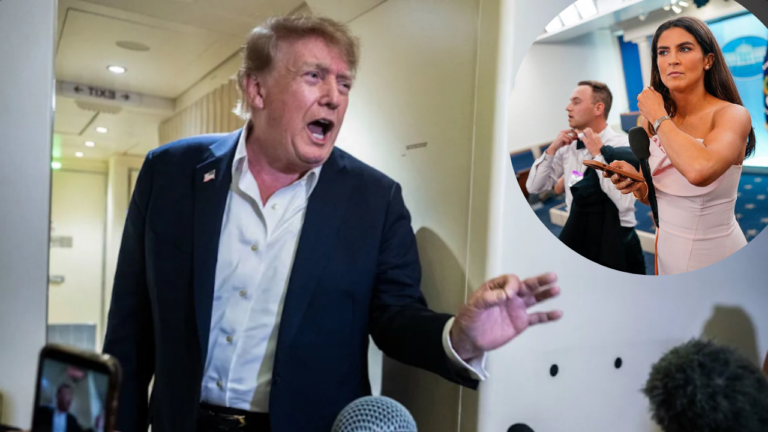
3. KAITLAN COLLINS GETS SINGLED OUT — AGAIN
Then came CNN’s Kaitlan Collins.
TIME challenged Trump over his administration’s restrictions on media organizations and asked why Americans should believe he respects a free press.
Trump responded by complaining about negative coverage.
“I never get good press. I never get fair press,” he argued.
Then Collins suddenly became the target.
“What’s the purpose of like this crazy Kaitlan Collins?” Trump asked.
He called the CNN correspondent “a very average person” before getting even more personal.
“She’s the most unhappy young person I’ve ever seen.”
Trump argued that even if he accomplished something “spectacular,” CNN would still portray him negatively.
The attack was especially notable because it came shortly after another public broadside against Collins, whom Trump recently accused of having a “TRUMP addiction.”
TIME then asked Trump a straightforward question: Isn’t holding powerful officials accountable a founding principle of a free press?
“It is,” Trump acknowledged, “but they got to treat you fairly.”
4. THE NEW YORK TIMES “MAY BE NEXT”
CNN wasn’t the only news organization in Trump’s sights.
The administration has already been embroiled in a legal battle over restricting White House access for CNN, MS NOW and Politico.
During the TIME interview, Trump appeared to float expanding that fight.
While discussing Iran, Trump complained about coverage in The New York Times, arguing that the newspaper was portraying Iran more favorably than he believed circumstances warranted.
Then came the line that stood out:
“Fake news, fake news, and maybe they’ll be next.”
Trump did not announce a formal ban against the Times during the interview.
But given his administration’s existing fight with other major news organizations, the comment immediately carried more weight than an ordinary complaint about coverage.
The president had already targeted three outlets.
Now he was openly suggesting another could be “next.”
5. WOULD HE PARDON HIS OWN ADMINISTRATION? “YEAH, SURE I’D DO THAT”
Another striking exchange came when TIME asked Trump what could happen if Democrats regain power.
Trump predicted Democrats would “go after” him — and said he would respond in kind.
That prompted a remarkably direct question.
Would Trump consider pardoning members of his own administration before leaving office?
His answer was equally direct.
“Yeah, sure I’d do that.”
When TIME asked whether he was seriously considering it, Trump immediately pointed to former President Joe Biden.
“Well, Sleepy Joe Biden, he gave pardons to everyone,” Trump said.
Biden did issue preemptive pardons before leaving office, including for Dr. Anthony Fauci, retired Gen. Mark Milley and members and staff of the House committee that investigated January 6. Biden said those pardons were intended to protect public servants from potential politically motivated prosecutions and were not acknowledgments of wrongdoing.
Trump did not identify specific members of his administration he might pardon or say that a decision had already been made.
But he certainly didn’t rule it out.
Quite the opposite.
“Sure I’d do that.”
And those weren’t the only eyebrow-raising moments.
While discussing artificial intelligence, Trump declared that he has “the highest of IQs” and cited his uncle’s long career at MIT while arguing that he understands emerging technology better than other presidents.
He also sparred repeatedly with TIME over Iran, the economy, data centers and his record in office.
But perhaps the most revealing thread running through the interview was Trump’s recurring frustration with criticism — whether it came from journalists covering him or Supreme Court justices he personally selected.
By the end, that frustration was no longer subtle.
“You haven’t asked me one f*cking positive question.”
For an interview about the state of Trump’s second presidency, it was quite an ending.
About the Author