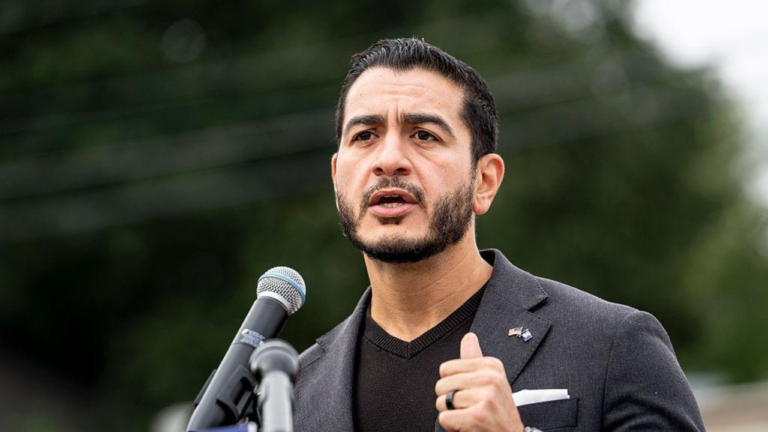
Abdul El-Sayed challenged conservative columnist Ross Douthat over the rising cost of raising children in America, arguing that politicians concerned about declining birth rates need to confront the financial pressures that make starting a family increasingly difficult.
During a conversation featured in material associated with 60 Minutes, the Michigan Democratic Senate candidate pressed Douthat, a father of five, on the realities of paying for childcare, healthcare and other expenses.
“How expensive is having kids? You have five of them. How expensive is it?” El-Sayed asked.
“I don’t know if my employers are watching this show. It’s considerably expensive,” Douthat replied, according to a transcript of the exchange.
El-Sayed then turned to the cost of childcare, suggesting that working parents can face expenses of approximately $2,000 per child.
“Think about the albatross that that sits on our economy,” he said. “Think about the premium that you have to pay for healthcare for all of your kids.”
The exchange became a broader argument about America’s declining birth rate and the financial obstacles facing younger generations.
El-Sayed described young people looking toward adulthood and questioning whether they could ever afford to become parents.
“So if the issue in our country is stagnation when it comes to the capacity to have children, the question we really ought to ask ourselves is, how do you make it easier to have kids?” he said.
His proposed starting point was straightforward.
“Maybe we should stop making it so expensive to have kids,” El-Sayed said.
He argued that public discussions about encouraging childbirth often focus on cultural attitudes and abortion restrictions while paying insufficient attention to the financial conditions under which families make decisions.
“And I get it, a lot of people are gonna say, ‘well, we’re gonna ban abortion and we’re gonna tell people it’s a good thing to have kids.’ Yeah, that doesn’t really quite work,” he said.
“What tends to happen is we ban abortions, people just get abortions, they’re just less safe.”
Douthat attempted to interject, but El-Sayed continued outlining his position.
“My point is this. Hear me out. You need to be invested in the means of making it easier to have children,” he said. “That means you have to address the rising costs of having kids.”
The argument reflects a larger policy debate over how governments should respond to falling fertility rates. Conservatives have proposed a range of approaches, including tax benefits and cultural initiatives, while other proposals focus on direct support for childcare, healthcare and housing.
El-Sayed argued that politicians cannot credibly call for more births while rejecting policies intended to reduce the cost of raising children.
“So if your argument is that we can’t have childcare, we can’t have healthcare, we can’t subsidize housing, we can’t do these things, do not be surprised when all of a sudden we age past the point at which we are viable,” he said.
He then directly criticized what he characterized as the priorities of Republican politicians who describe themselves as pro-natalist.
“The party that wants to tell me that they’re pro-natalist, their solution is let’s cut taxes for the billionaires and let’s go to war as we have no business fighting and somehow if we rub two sticks together, we’re gonna get people to wanna have kids,” El-Sayed said.
“It’s not serious. So I’m just trying to be serious about what the problem is.”
His remarks presented a clear economic argument: encouraging Americans to have children requires addressing the costs and practical challenges of parenthood, not simply promoting family formation as a cultural ideal.
El-Sayed closed by returning to the central question.
“And I think the problem is we have made it too expensive. And if we cannot make it cheaper, do not be surprised when people don’t have kids.”
About the Author