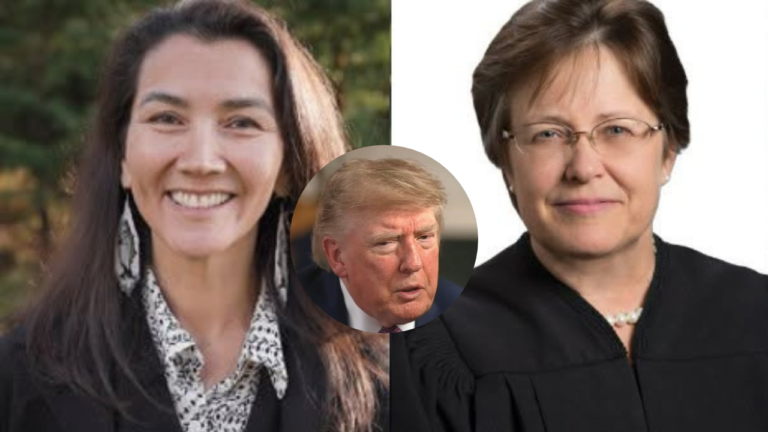
A federal judge has thrown out the Trump administration’s last-minute lawsuit seeking to delay certification of Alaska’s Senate election results if Republican incumbent Dan Sullivan loses, rejecting an extraordinary Justice Department request just two days before the midterm elections.
U.S. District Judge Sharon Gleason dismissed the case Sunday, November 1, finding that federal officials had failed to establish a workable legal basis for the intervention they wanted.
At the center of the dispute is an unusual ballot situation: Alaska voters will see two Senate candidates named Sullivan.
One is Republican Sen. Dan S. Sullivan, who is seeking reelection against Democrat Mary Peltola. The other is Daniel J. Sullivan Jr., a retired teacher from Petersburg running without a party affiliation.
Trump and other Republicans have accused Democrats of helping place the second Sullivan on the ballot to confuse voters and potentially draw support away from the incumbent.
The Justice Department filed suit in October, seeking to prevent Alaska from certifying an election result that might have been affected by confusion between the two candidates.
Federal attorneys wanted election officials to preserve and separate ballots ranking Daniel J. Sullivan so investigators could later determine whether voters had intended to support the Republican senator.
But Gleason found a fundamental problem with that proposal.
Alaska uses ranked-choice voting, allowing voters to rank multiple candidates on a single ballot. Election officials argued that identifying and separating ballots based on individual choices would create serious practical difficulties and threaten the secrecy of the vote.
The judge agreed that the federal government had failed to explain how its requested investigation could be carried out while protecting voters’ privacy.
She also concluded that the Justice Department had not demonstrated that a federal court could provide the remedy it sought, a requirement for the government to establish legal standing.
The timing created another obstacle. Early voting had already begun, and changing ballot-handling procedures immediately before Election Day would risk disrupting an election already underway.
The ruling also addressed the constitutional authority of states to administer their own elections.
Alaska officials had argued that the federal government was attempting to impose an extraordinary new procedure without a sufficient legal foundation.
The state’s ballots already distinguish the candidates. The Republican incumbent is identified as Dan S. Sullivan, while the other candidate appears as Daniel J. Sullivan Jr., without a party affiliation.
The Alaska Supreme Court previously ruled that the second Sullivan was entitled to appear on the ballot.
The allegations surrounding his candidacy have not disappeared, however.
Reports have raised questions about whether Democratic operatives were involved in encouraging him to run. Peltola has denied knowing about such an effort, and Daniel J. Sullivan has maintained that his candidacy is legitimate.
Federal authorities are separately investigating allegations surrounding the candidate’s entry into the race. Sunday’s civil ruling did not resolve those allegations or determine whether any election-related crime occurred.
The Justice Department has said it intends to appeal the dismissal.
For now, however, Gleason’s decision leaves Alaska’s existing election procedures in place rather than imposing the special ballot-segregation system requested by the Trump administration.
The ruling comes at a sensitive moment for the state, where the Senate contest has drawn national attention because of its potential importance to control of Congress.
With Election Day approaching, the court’s message was clear: the federal government had not demonstrated a lawful, workable way to carry out the extraordinary intervention it requested.
About the Author