Donald Trump’s legal battle with The Wall Street Journal over its reporting on an alleged birthday letter to Jeffrey Epstein has suffered another major setback — and this time, the federal judge has shut the door on another amended complaint.
U.S. District Judge Darrin Gayles dismissed the president’s $10 billion defamation lawsuit on Saturday, October 31, ruling that Trump’s lawyers had again failed to establish a legally sufficient claim against the newspaper and its parent company.
The dismissal was issued with prejudice, meaning Trump cannot simply rewrite his complaint and file the same lawsuit again in the district court.
His legal team is expected to appeal.
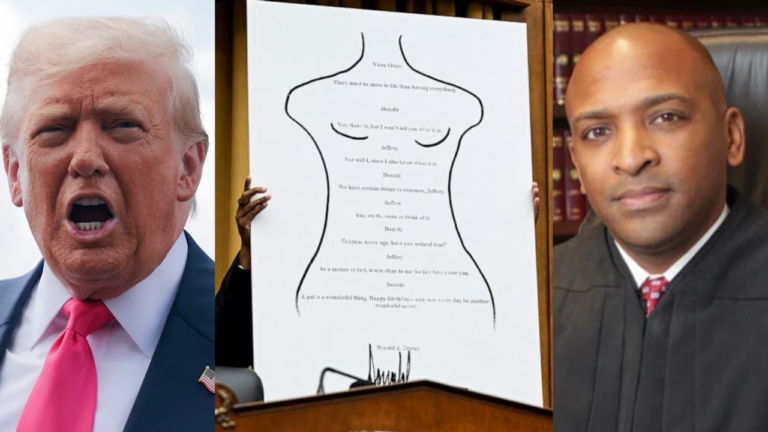
The lawsuit stemmed from a Wall Street Journal report about a sexually suggestive letter allegedly bearing Trump’s name in a birthday album prepared for Epstein’s 50th birthday in 2003.
According to the newspaper, the letter included a drawing of a naked woman and ended with the words, “Happy Birthday — and may every day be another wonderful secret.”
Trump has repeatedly denied writing or signing the letter, calling the newspaper’s reporting false and malicious.
He sued the Journal, its reporters, media mogul Rupert Murdoch and other defendants, seeking billions of dollars in damages.
But the case ran into a significant legal obstacle.
Under the Supreme Court’s landmark New York Times v. Sullivan decision, public officials pursuing defamation claims must establish actual malice — meaning that the defendant published a false statement knowing it was false or with reckless disregard for whether it was true.
Gayles found that Trump’s amended complaint still failed to meet that standard.
“The Amended Complaint falls short of pleading actual malice,” the judge wrote.
He described the allegations as vague, conclusory and, in some instances, inconsistent with the newspaper’s own reporting.
The judge also took aim at Trump’s effort to portray the Journal’s investigation as fundamentally defective.
“Grasping at straws, the Amended Complaint attempts to manufacture flaws with the investigation,” Gayles wrote.
The court noted that the Journal had sought Trump’s response before publishing its story and had included his denial in the article itself.
That mattered because Trump’s lawyers argued that the newspaper should not have published the allegations after the president disputed them.
Gayles rejected that reasoning, explaining that a subject’s denial does not automatically establish that journalists acted with actual malice by publishing a report.
The judge had already dismissed Trump’s original complaint earlier in 2026, but he allowed the president to submit an amended version.
Trump’s lawyers did so in May.
Saturday’s ruling concluded that the revised allegations remained insufficient.
“As with his first attempt, he has failed,” Gayles wrote.
The case attracted particular attention because the newspaper’s reporting concerned Trump’s past association with Epstein, the convicted sex offender who died in federal custody in 2019 while awaiting trial on sex-trafficking charges.
The Journal reported that Ghislaine Maxwell had collected contributions from Epstein’s acquaintances for the birthday album.
The disputed letter later became the subject of congressional attention after lawmakers obtained materials from Epstein’s estate.
Trump has continued to insist that the letter is not authentic.
The ruling does not establish that Trump wrote the letter or that every factual assertion in the Journal’s reporting is true. It addresses whether his lawsuit adequately alleged the legal elements required for a public figure to pursue a defamation claim.
The president’s legal representatives responded defiantly.
“President Trump will continue to press forward in his powerhouse lawsuit against the Wall Street Journal and all of the other defendants,” a spokesperson for his legal team said.
A source familiar with Trump’s legal strategy told CBS News that an appeal was likely.
For now, however, the district court has rejected the president’s second attempt to pursue the claim.
And after giving Trump’s lawyers another opportunity to make their case, the judge made clear that they would not receive a third chance to rewrite it in his courtroom.
About the Author