Donald Trump is facing an increasingly uncomfortable reality on the economy, and CNN’s Kaitlan Collins just put some of that frustration directly in front of viewers.
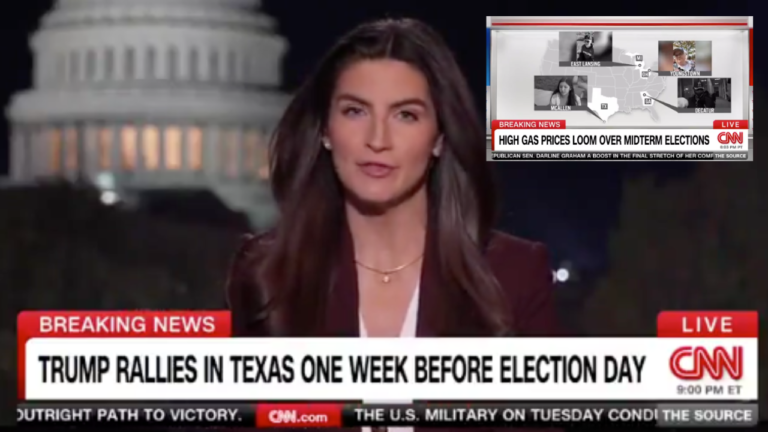
During Tuesday’s broadcast, Collins aired a striking montage of Americans across several states describing their anger over rising gas prices, expensive groceries and the growing difficulty of affording everyday life.
Some were simply frustrated. Others were openly questioning the president’s promises.
But one voter delivered an especially harsh assessment — and admitted that he had voted for Trump.
“I voted for him, I can’t lie,” the man said during an interview in East Lansing, Michigan.
“But seeing how he’s just been a tyrant with his power, to be honest with you, is the best way to describe it. Starting wars that were not needed to be started. Gas prices have continuously gone up.”
It was a remarkable statement from someone who had supported the president, and it captured the frustration running through the segment.
Another man in East Lansing focused on the promises Trump made to voters before returning to the White House.
“I think just the way we were promised just basic necessities, lower gas prices. We want to be able to buy a house. We want to be able to have a family,” he said.
“And I haven’t seen … those things were promised to us.”
The complaints were not confined to Michigan.
In McAllen, Texas, a woman described watching her parents struggle with rising household expenses.
“I’ve seen it a lot with my parents, how gas prices, grocery prices, how like before it was way easier to buy all that stuff,” she said.
In Decatur, Georgia, another voter expressed a similar frustration.
“Gas prices is crazy. Food prices really ridiculous, you know. We just gotta make a change.”
And in Youngstown, Ohio, a woman said she was unhappy with prices at the pump.
Although she acknowledged that she did not know exactly what was driving the increases, she believed Trump needed to bring them down.
Two other men in the city offered similarly bleak descriptions of fuel prices, calling them “high” and “rough right now.”
Taken together, the interviews presented a picture of Americans who feel squeezed by the cost of living and are increasingly impatient for relief.
The montage was particularly significant because Trump made affordability a central part of his political appeal, repeatedly promising that his policies would lower costs for ordinary Americans.
Now, with the war involving Iran contributing to turmoil in energy markets, gasoline prices have become a particularly visible source of public frustration.
The precise causes of rising fuel prices are complex, involving global oil supplies, market expectations and geopolitical uncertainty. But voters experiencing higher prices at the pump are judging the administration by the promises it made.
And Collins was not finished.
After showing the interviews, she turned to Trump’s own public comments about the oil industry and his repeated assurances that fuel prices would soon decline.
The president has recently highlighted the substantial profits being made by major oil companies while maintaining that Americans will eventually see relief.
Collins suggested viewers might recognize the pattern.
“If you’re thinking, ‘I’ve heard that before,’ it’s because you have,” she said.
She then aired another montage — this time featuring Trump himself, repeatedly predicting that prices would come down.
The contrast was the point.
On one side were voters describing the financial strain they were experiencing right now.
On the other was the president repeatedly promising that the situation would improve.
For an administration that has emphasized economic success, the segment offered a pointed reminder that voters tend to judge economic performance through their own expenses rather than political talking points.
The interviews also illustrated a political vulnerability for Trump.
Dissatisfaction with prices is one thing. Hearing someone who voted for him describe him as a “tyrant” while criticizing his foreign policy is another.
That voter connected two issues that have become increasingly difficult for the White House to separate: the economic consequences of the Iran war and the president’s decisions about the conflict itself.
The man did not merely complain about expensive gasoline. He questioned whether the war should have happened at all.
That does not mean every Trump voter shares his view, and a collection of television interviews cannot establish how the broader electorate feels.
But the comments demonstrate that at least some Americans who previously supported Trump are now willing to criticize him in unusually direct terms.
Collins’ presentation also gave viewers a way to compare the administration’s assurances with the experiences of people in different parts of the country.
The president continues to argue that his economic and foreign policies will deliver long-term benefits.
For the voters featured in the CNN segment, however, those promised benefits have yet to resolve the problems they face when buying groceries, filling their tanks or trying to plan for a family.
And as the midterm elections approach, that gap between promises and everyday reality could become an increasingly difficult political problem for Republicans.
The most memorable moment of Collins’ segment was not a statistic or a political argument from a Washington insider.
It was a voter who had supported Trump, looking into a camera and explaining why he no longer liked what he was seeing.
Collins let his words speak for themselves — and then played the president’s own promises back to the audience.
The average price of a gallon of gas nationwide is now a $1.29 higher than before the start of the Iran war. Despite voters’ concerns, President Trump continues to tout how much money big oil companies are making because of it. Our opening tonight: https://t.co/PlMmy6SIF3
— Kaitlan Collins (@kaitlancollins) October 28, 2026
About the Author