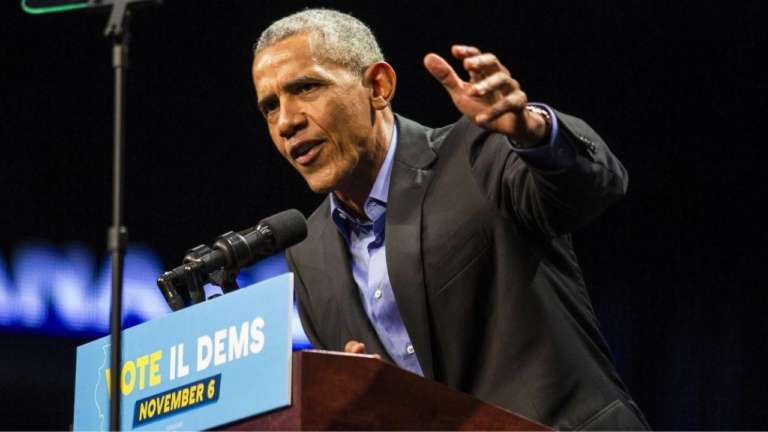
Former President Barack Obama is delivering a pointed warning to Democrats as the 2026 midterm elections approach, cautioning that even an unexpectedly favorable political environment offers no guarantee of victory.
With less than a month remaining before Americans head to the polls on November 3, Obama is increasing his involvement in Democratic campaigns across the country, raising millions of dollars, recording advertisements, endorsing candidates, and preparing for major appearances in competitive states.
But behind the growing optimism surrounding the party’s prospects, the former president sees a serious danger: Democrats becoming convinced that victory is inevitable.
During a Democratic Senatorial Campaign Committee fundraiser in Virginia on Wednesday, October 7, Obama warned donors that several closely contested Senate races could still slip away, even in states where Democratic candidates have demonstrated surprising strength.
“I don’t want anybody to think this is a sure thing. It’s not,” Obama said, according to remarks obtained by ABC News.
The former president pointed to contests where Democrats are polling within striking distance of Republican opponents, including races that would have seemed highly unlikely to become competitive earlier in the election cycle.
He described the situation as being “on the razor’s edge.”
Obama’s assessment reflects an unusual political moment.
Democrats are attempting to expand their electoral map into states that have historically favored Republicans, while President Donald Trump’s administration faces criticism over rising living costs, tariffs, and its handling of international conflicts.
The former president specifically identified Texas as a state he had not expected Democrats to have a serious opportunity to contest.
He also mentioned Kansas, Nebraska, and Georgia as examples of races attracting attention.
For Democrats, that expanding map creates opportunities. But it also introduces uncertainty.
A race that appears competitive in October can still produce a disappointing result in November, particularly when the difference between candidates is only a few percentage points.
Obama reminded donors that narrow polling advantages are not the same as votes already counted.
He warned that Democrats could lose several close contests even if current surveys suggest they are competitive.
The remarks offer a contrast to some of the more confident public messaging coming from Democratic leaders as Election Day approaches.
Party officials have increasingly emphasized their efforts to compete in Republican-held territory, hoping to capitalize on voter frustration with the Trump administration.
But Obama is urging the party to treat that opportunity as a reason to work harder rather than assume the outcome is settled.
His warning comes as he takes on a more prominent role in the campaign.
According to ABC News, the Virginia fundraising event generated approximately $3.6 million for Democratic Senate efforts.
Obama’s office said the former president has helped raise approximately $13.6 million for party committees during the current election cycle.
That financial support is only one part of his expanding political involvement.
Obama has also recorded advertisements and endorsement videos for Democratic candidates in several states, including Pennsylvania, Georgia, New Mexico, Wisconsin, and Maine.
Among the candidates receiving his support are Pennsylvania Governor Josh Shapiro, Georgia gubernatorial candidate Keisha Lance Bottoms, New Mexico gubernatorial candidate Deb Haaland, Wisconsin gubernatorial candidate David Crowley, Georgia Senator Jon Ossoff, and Maine Senate candidate Troy Jackson.
His endorsements illustrate the breadth of the party’s ambitions.
Democrats are defending competitive seats while simultaneously trying to make inroads in states where Republicans have enjoyed significant advantages.
The former president has also appeared in campaign activities in Texas, supporting Democratic Senate candidate James Talarico and gubernatorial candidate Gina Hinojosa.
His involvement there reflects the changing calculations within the Democratic Party.
Texas has long represented an elusive statewide prize for Democrats, despite repeated efforts to make the state competitive.
Obama’s comments suggest that party leaders now see an opening worth pursuing, even while recognizing the substantial challenges involved.
The former president is also scheduled to appear in Michigan on October 24, campaigning alongside Democratic Senate nominee Abdul El-Sayed and gubernatorial candidate Jocelyn Benson.
That appearance will bring Obama into one of the states central to the national political battle.
Michigan has been a major focus of both parties, and its open Senate contest has attracted significant national attention.
Obama’s decision to campaign alongside El-Sayed also carries an important message about Democratic unity.
El-Sayed, a progressive candidate who defeated a more moderate opponent in the Democratic primary, represents a wing of the party whose priorities have sometimes produced disagreements with its centrist leadership.
But Obama has emphasized the importance of maintaining a broad coalition.
At the Virginia fundraiser, he defended the party’s ideological diversity and pointed to El-Sayed’s support for policies such as a higher minimum wage and expanded healthcare access.
The former president suggested that those priorities should not automatically be treated as outside the Democratic mainstream.
His remarks underscore the challenge facing a party attempting to unite voters with different political priorities while confronting a Republican administration.
Some Democratic candidates are focusing heavily on economic issues, particularly the cost of living and the effects of tariffs.
Others are emphasizing healthcare, government accountability, democratic institutions, and the consequences of Trump’s foreign-policy decisions.
Obama’s message is that the party must connect those national concerns to the daily experiences of voters.
He has highlighted candidates who speak directly to communities affected by economic pressures, including farmers dealing with tariffs and disruptions connected to the war involving Iran.
That approach reflects a familiar element of Obama’s political strategy.
Rather than treating elections solely as contests between national political personalities, he has emphasized the importance of making voters feel that their specific concerns are understood.
The challenge is especially significant in states where Democrats have struggled to build durable electoral support.
A candidate may benefit from national dissatisfaction with the president without necessarily persuading voters that the opposition party offers a credible alternative.
Obama’s expanding campaign schedule suggests he believes direct engagement could make a difference in those places.
The former president remains one of the Democratic Party’s most recognizable figures, and his participation provides candidates with access to national attention and fundraising networks.
His involvement also comes as Democratic leaders seek to connect dissatisfaction with the Trump administration to concrete electoral choices.
But Obama’s warning illustrates the limits of relying on national political momentum alone.
Competitive polls do not guarantee high turnout.
Fundraising success does not eliminate the need for effective campaigns.
And a favorable political environment does not ensure that voters will support every candidate running under the same party label.
Those realities are particularly important in Senate elections, where the outcome of a handful of state contests can determine control of the chamber.
Even relatively small shifts in voter participation could affect the final results.
Obama’s remarks also highlight the pressure surrounding the closing weeks of the campaign.
Both parties are directing substantial resources toward advertising, organizing, and voter outreach.
Republicans are working to defend their congressional majorities, while Democrats are attempting to turn public dissatisfaction into gains in the House and Senate.
The outcome will shape the remainder of Trump’s presidency.
Congressional control affects legislation, government spending, oversight, investigations, and the administration’s ability to advance its agenda.
For Democrats, the stakes extend beyond simply winning additional seats.
Regaining control of either chamber would provide new institutional tools to scrutinize administration decisions and challenge policies they oppose.
But those possibilities depend on actual election results, not encouraging headlines or favorable polling.
Obama’s intervention is therefore both a message of opportunity and a warning about the work still ahead.
The former president sees Democrats competing in places that once seemed out of reach.
He is raising money, appearing in advertisements, endorsing candidates, and preparing to campaign in closely watched states.
At the same time, he is reminding his party that a competitive election is not a completed victory.
The contrast is what makes his remarks notable.
Obama is not dismissing the opportunities facing Democrats.
He is acknowledging how unusual some of those opportunities have become.
But he is also warning that every close race remains vulnerable to a shift in turnout, voter sentiment, or campaign performance.
With November 3 approaching, the former president’s message leaves Democrats with a straightforward challenge: convert political opportunity into actual votes.
And until those votes are counted, the outcome remains uncertain.
About the Author