
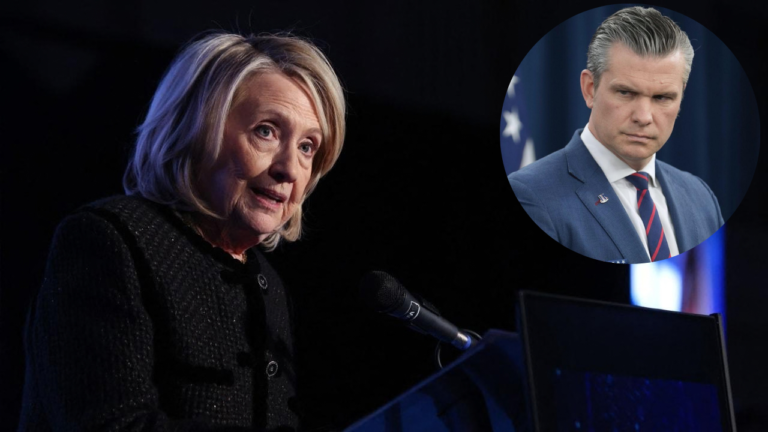
Hillary Clinton has delivered a sharp rebuke of Defense Secretary Pete Hegseth over the Pentagon’s controversial proposal to publicly livestream a military execution, calling the idea barbaric and urging Americans to push back against it.
The former secretary of state entered the growing controversy on Friday, October 9, after reports emerged that the Pentagon intended to broadcast the execution of Nidal Malik Hasan, the former Army psychiatrist convicted of killing 13 people and wounding 32 others in the 2009 Fort Hood shooting.
Clinton’s response was brief, but unmistakable.
“A barbaric idea, beneath our dignity as a country. Push back on this.”
Those words placed Clinton among a growing group of critics challenging not Hasan’s conviction, but the extraordinary decision to turn the carrying out of his death sentence into an event that could be watched by the public.
And some of the criticism has come from Republicans.
Hegseth has defended the proposed public execution as a demonstration of the consequences of mass violence. Speaking about the plan, the defense secretary said the government would make sure people could watch, arguing that the punishment should send a clear message.
“We’ll make sure that people are able to watch it, that it’s public,” Hegseth said.
The Pentagon announced that Hasan’s execution was scheduled for December 3, 2026, at Fort Hood, Texas, the military installation where the deadly attack took place.
The execution would be carried out by firing squad, a method rarely used in modern American military justice.
If the sentence is carried out, it would be the first execution conducted by the United States military since 1961.
But the proposed livestream has become the most contentious element of the administration’s plan.
Public executions largely disappeared from American life generations ago, and a government-sponsored livestream of a military execution would represent a significant departure from contemporary practice.
Hegseth has spoken approvingly of the historical use of firing squads and emphasized the symbolism of carrying out Hasan’s sentence at the site of the original attack.
For the defense secretary, public visibility appears to be part of the punishment’s intended message.
For Clinton and other critics, that is precisely the problem.
Their objection is that the government can enforce a criminal sentence without transforming the death of a prisoner into a public spectacle.
Clinton’s criticism is particularly notable because she has not historically supported abolishing the death penalty in every circumstance.
During her 2016 presidential campaign, she argued that capital punishment should be reserved for rare and exceptionally serious cases while acknowledging concerns about wrongful convictions and discrimination.
Her latest statement did not call for Hasan’s release, question his conviction, or explicitly demand that his death sentence be overturned.
Instead, she focused on the proposed broadcast itself.
That distinction has also shaped criticism from Republicans.
Senator Thom Tillis of North Carolina, who supports Hasan’s death sentence, condemned the idea of livestreaming the execution.
Tillis described the proposal as “beyond disgusting,” drawing a distinction between carrying out a lawful punishment and broadcasting it to a potentially enormous audience.
Republican Senator Lisa Murkowski of Alaska also objected, arguing that such practices are associated with authoritarian governments rather than the United States.
Democratic Senator Chris Murphy questioned whether the administration was adopting tactics reminiscent of extremist organizations that have used execution footage as propaganda.
The bipartisan criticism has created an unusual political confrontation.
The disagreement is not simply between supporters and opponents of capital punishment.
It concerns whether the American government should deliberately make an execution available for public viewing, potentially allowing footage to circulate indefinitely across television, websites, and social media.
The United Nations has also criticized the proposal, while military justice experts and religious leaders have raised concerns about the legal, ethical, and practical consequences.
Some critics warn that distributing footage of Hasan’s execution could inadvertently provide material for extremist propaganda, given the ideological motivations he cited for his 2009 attack.
Others question whether broadcasting an execution would deter future violence or merely turn punishment into entertainment.
The underlying crime remains among the deadliest attacks ever carried out at an American military installation.
On November 5, 2009, Hasan opened fire at Fort Hood, killing 13 people and wounding 32 others.
He was convicted at a military court-martial in 2013 and sentenced to death.
The severity of those crimes is not in dispute.
But the debate surrounding his punishment has moved beyond the facts of the original attack and into a broader argument over the limits of state power.
The controversy has also exposed uncertainty within the Trump administration itself.
Although the Pentagon announced plans to livestream the execution, President Donald Trump subsequently indicated that the final decision about broadcasting it had not been made.
Asked about the proposal, Trump said he would make a determination, suggesting that he was considering competing arguments.
Vice President JD Vance also expressed uncertainty about whether the livestream would actually happen.
Those comments complicate the Pentagon’s earlier announcement and leave the broadcast’s status unresolved.
The execution date has been announced, but the government has not established that the public broadcast will definitely proceed.
Legal challenges could also affect the timing of the execution.
Hasan may still seek relief through civilian federal courts, and any such proceedings could delay the sentence’s implementation.
Meanwhile, the administration has not announced where a livestream would be hosted or how the footage would be distributed.
Those unanswered questions underscore how unusual the proposal is.
American executions have traditionally been conducted under strict procedures, with access limited to authorized witnesses, officials, and in some circumstances members of the media.
A livestream would fundamentally change the scale of public access.
Instead of a small number of witnesses observing a sentence carried out under government supervision, potentially millions of people could watch the event in real time.
Recordings could then circulate long after the execution itself.
Supporters of greater public access argue that the government should be transparent about punishments imposed in the public’s name.
But opponents maintain that transparency does not require turning the final moments of a prisoner’s life into a broadcast event.
For Clinton, the question appears to be one of national dignity.
Her statement suggests that even when the government possesses the legal authority to carry out a death sentence, it must still consider how that punishment reflects the country’s values.
The debate also arrives at a moment when the Pentagon’s leadership has faced intense political scrutiny over its public messaging and the conduct of military operations.
Hegseth has frequently emphasized strength, deterrence, and a more aggressive approach to military policy.
The proposed public execution fits within that emphasis on visible consequences, but it has also brought objections from people who otherwise agree that Hasan should face the punishment imposed by the military court.
That disagreement makes the controversy difficult to reduce to ordinary partisan divisions.
Clinton is a prominent Democrat and longtime political opponent of Trump.
Yet her criticism overlaps with objections from Republican lawmakers who have supported the death penalty and, in some cases, the administration’s broader policies.
Their shared concern is not necessarily the sentence itself.
It is the decision to make the execution a public event.
The distinction matters because the administration still has an opportunity to reconsider the broadcast without necessarily changing the underlying punishment.
Trump’s comments indicate that the final decision remains open.
As the December 3 date approaches, the White House will face continued questions about whether the livestream serves a legitimate public purpose and whether its potential consequences have been adequately considered.
For the families of those killed and wounded at Fort Hood, the case remains rooted in a devastating act of violence that changed their lives.
For the administration, the execution represents the enforcement of a military death sentence imposed more than a decade ago.
But for Clinton and the lawmakers now challenging the broadcast, the question is whether justice requires a public display of death.
The former secretary of state has made her position unmistakable.
She called the proposal barbaric, said it was beneath the dignity of the United States, and urged the public to oppose it.
Whether the White House ultimately proceeds with the livestream remains to be seen.
What is already clear is that the proposal has produced objections that cross party lines, turning an extraordinary Pentagon announcement into a broader national debate over punishment, public spectacle, and the responsibilities of the American government.
SOURCES:
About the Author


A public execution of Nadal by a firing squad will lead to more of what Nadal was convicted of. “The strength of the law is sin and sin the law.” (First Corinthians 15:56) But THAT is precisely what Hegseth wants. Remember what Dirty Harry used to say to gun-toting criminals: “Go ahead – make my day.” Pete Hegseth is The Dirty Harry of 2026. Dirty Harry has made progress since 1983 when he was an Inspector in an ordinary local police department. Today in 2026 he is The Secretary of War or if you prefer Defense. In 1983 he used a handgun. Today in 2026 he controls the Nuclear Firepower needed to kill The Human Race several times. As Jesus said 2000 years ago: “…such things must be and the end is not yet…” (Matthew 24:14) Amen?