
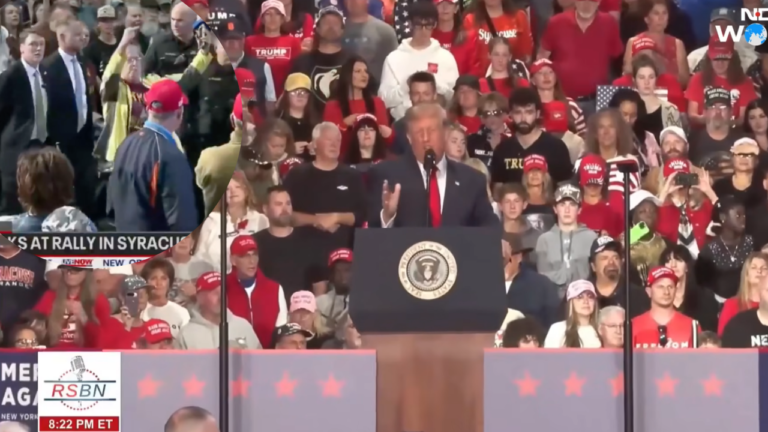
Donald Trump traveled to Syracuse, New York, on Friday to help a Republican candidate win the governor’s race. But before the evening was over, the president had turned a significant portion of his campaign speech into a public confrontation over an award he has repeatedly insisted he deserves: the Nobel Peace Prize.
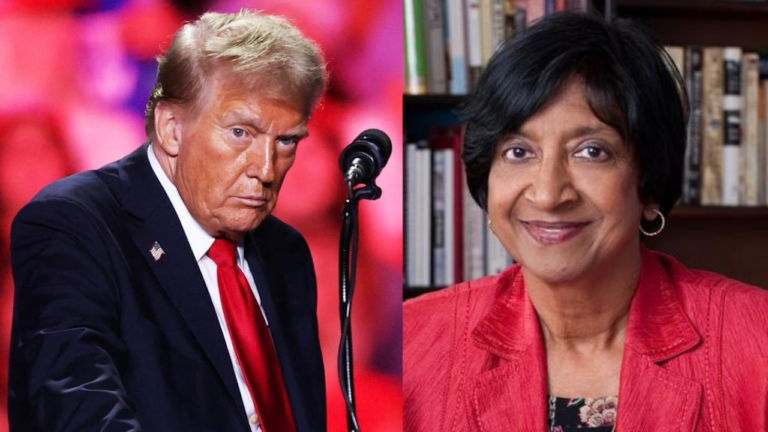
The president’s frustration was on full display after the Norwegian Nobel Committee awarded its 2026 Peace Prize to Navi Pillay, the South African human rights lawyer and former United Nations human rights chief whose career has been devoted to international justice.
Trump was not impressed.
Instead of simply acknowledging the committee’s decision, he spent roughly ten minutes criticizing the award, questioning the qualifications of its recipient, and arguing that his own diplomatic record should have earned him the honor.
He called Pillay a “mystery person” and told the crowd that he had never heard of her.
He also directed his frustration toward Norway, declaring that the decision had left an “indelible stain” on the country and warning that he would not forget the rejection.
There was one significant problem with that argument: the Norwegian Nobel Committee operates independently of Norway’s government. Its members are appointed by parliament, but the committee makes its own decisions under the terms of Alfred Nobel’s will.
Trump’s criticism nevertheless continued.
The president repeatedly returned to his claim that he had helped resolve eight international conflicts, presenting those diplomatic efforts as evidence that he deserved the Nobel Peace Prize.
But those assertions have been challenged by independent reporting. Some of the conflicts Trump counts as resolved have continued, while others involved diplomatic efforts by multiple governments or were not full-scale wars in the first place.
The distinction is particularly relevant given the ongoing conflict involving Iran and the continuing war between Russia and Ukraine, both of which Trump has invoked while describing his record as a peacemaker.
The president’s comments also came against a striking political backdrop.
The Syracuse rally was intended to promote Bruce Blakeman, the Republican candidate challenging Democratic Governor Kathy Hochul in November.
With the midterm elections approaching, Republicans are attempting to expand their appeal in states and districts where Trump remains a polarizing figure.
But the president’s extended discussion of the Nobel Prize shifted attention away from Blakeman’s campaign and toward Trump’s own grievances about international recognition.
The contrast became even more pronounced when Trump turned his attention to Pillay.
Far from being an obscure figure, the 85-year-old jurist has spent decades working in international human rights law.
Born in South Africa during apartheid, Pillay became a pioneering attorney who challenged racial discrimination before serving as a judge on the International Criminal Tribunal for Rwanda.
She later became a judge at the International Criminal Court and served as the United Nations High Commissioner for Human Rights from 2008 to 2014.
Her work has included efforts to strengthen accountability for genocide, crimes against humanity, and other serious violations of international law.
The Nobel Committee cited precisely that record when announcing its decision on October 9.
The award recognized Pillay’s contributions to peace and international law, particularly her role in strengthening legal institutions designed to hold governments and individuals accountable for grave abuses.
Her work has not been without controversy.
Pillay chaired a United Nations commission that concluded Israel had committed genocide in Gaza, a finding rejected by Israel and disputed by its supporters.
Trump seized on that controversy while criticizing the committee’s selection.
But disagreement with Pillay’s findings does not erase her extensive professional history, nor does it make her an unknown figure in international law.
The president’s criticism extended beyond the rally.
In a lengthy Truth Social statement, Trump explicitly argued that his record justified not merely one Nobel Peace Prize, but eight.
“In actuality, I should have won 8 Nobel Peace Prizes, not just 1,” he wrote.
He also credited himself with preventing additional conflicts, securing hostage releases, strengthening NATO, and saving an extraordinary number of lives.
Those claims were presented as part of a sweeping argument that the Nobel Committee had failed to recognize his accomplishments.
Trump went further, accusing the Nobel institution of being influenced by radical political ideologues and suggesting that its credibility had been permanently damaged.
The committee, however, has defended its independence and emphasized that its responsibility is to recognize contributions to peace according to the criteria established by Alfred Nobel.
Its chairman, Jørgen Watne Frydnes, declined to engage directly with Trump’s criticism but explained that the award was intended to recognize someone who had helped advance a stronger international legal order.
That distinction highlights the central disagreement.
Trump has emphasized direct negotiations, military pressure, ceasefires, and diplomatic agreements when making the case for his own recognition.
The committee chose instead to honor a career dedicated to human rights, legal accountability, and international institutions.
Those are different approaches to international peace, and the Nobel Committee’s decision does not constitute a comprehensive judgment on every diplomatic action taken by the Trump administration.
But Trump’s response turned that decision into a personal political controversy.
Even the Nobel laureate herself addressed the attention surrounding the president.
Speaking at a human rights conference in Germany, Pillay joked that she might share the prize with Trump if the audience applauded a little more.
The remark drew laughter, although Nobel rules make clear that an awarded prize cannot subsequently be transferred or shared.
Meanwhile, the political consequences of Trump’s Syracuse appearance extended beyond the Nobel dispute.
More than a thousand demonstrators gathered outside the rally venue, according to The Washington Post, while some local Republicans had expressed reservations about attending the event.
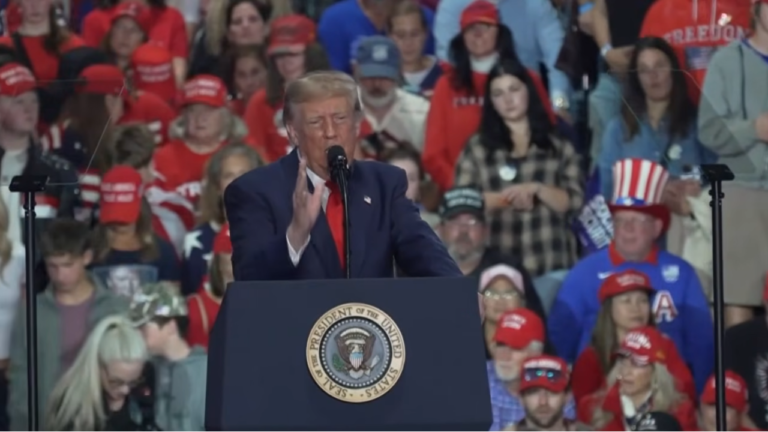
Inside, Trump delivered a lengthy speech covering domestic politics, foreign affairs, and his administration’s record.
Yet his extended complaints about the Nobel Prize became one of the most widely discussed portions of the appearance.
The president had come to New York to make the case for a Republican candidate.
Instead, he also made an unusually emphatic case for why he believed the world’s most prestigious peace award should have gone to him.
And the controversy did not end when he left the stage.
His subsequent social media statement expanded the argument, criticized the actual recipient, and asserted that eight Nobel Peace Prizes would have been justified by his record.
The episode illustrates how a decision made by an independent international committee became the focus of a presidential campaign appearance thousands of miles away.
Navi Pillay received the 2026 Nobel Peace Prize for her decades of work advancing international justice.
Donald Trump received no such award.
And at a rally intended to influence the upcoming midterm elections, the president made certain that the audience heard exactly what he thought about that distinction.
About the Author

Can you imagine any past president, or indeed any other world leader, acting like a spoiled 6 year old prattling on about not winning the Nobel Peace Prize? Does this not bother you even if you’re a GOP voter? It’s pathetic. And embarrassing.
And not only is he lying when he babbles about ‘ending 8 wars’, but he started a war against Iran, kidnapped the leader of Venezuela and is illegally blockading Cuba.
If it wasn’t all so absurd you’d laugh. But you can’t because among other crimes he has killed a school full of girls and murdered hundreds in boats off the coast of South America. And now he’s buying Russian diesel and blaming Ukraine for a war where they were the ones attacked. He is ignorant. Demented. A war criminal.
Yet he whines about not being awarded a prize that is awarded for doing the opposite of what he has done.