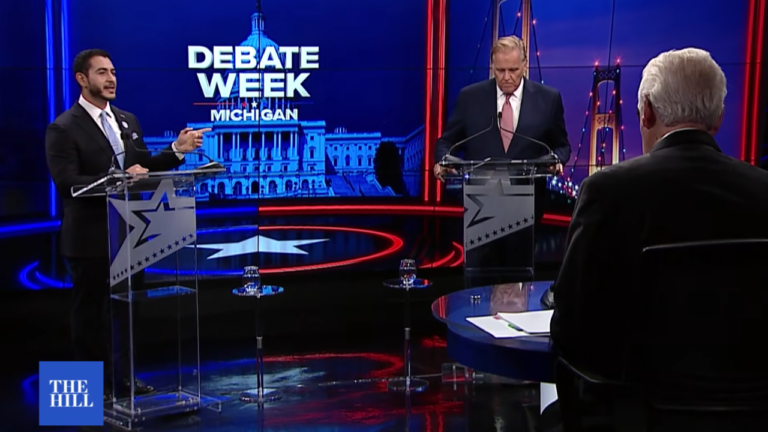
A Michigan Senate debate was already getting personal Thursday night when Democrat Abdul El-Sayed suddenly turned to Republican Mike Rogers with a question that had little to do with the issue the candidates were supposed to be discussing.
“How many yachts?”
As Rogers continued talking, El-Sayed raised two fingers toward the television cameras, silently emphasizing an accusation that has become a recurring theme of his campaign against the former Republican congressman.
The exchange unfolded during the candidates’ first debate in Grand Rapids, Michigan, where disagreements over President Donald Trump’s policies repeatedly gave way to sharp personal attacks.
And this particular confrontation began with a subject that matters enormously to Michigan’s economy: Trump’s trade war with Canada.
Rogers had recently called for an end to the tariff dispute, declaring that Canada was not America’s enemy and that the two countries needed to reach an agreement.
That position marked a notable change in tone for a Republican who had previously supported Trump’s tariff policies.
When the issue came up during Thursday’s debate, Rogers rejected the suggestion that he had reversed himself.
“We didn’t change,” Rogers insisted, arguing that circumstances had evolved and that he wanted a negotiated resolution.
El-Sayed was not convinced.
He accused Rogers of changing his position only when the political consequences became uncomfortable, calling him weak and unwilling to challenge Trump.
Then the Democrat shifted the argument from tariffs to his opponent’s financial history.
El-Sayed alleged that Rogers had benefited financially from corporate lobbying and consulting work after leaving Congress, including what his campaign describes as a $14 million payout connected to pharmaceutical lobbying.
Rogers has disputed that characterization.
The Republican objected forcefully during the debate, accusing El-Sayed of hypocrisy over his own campaign’s financial support.
Moderator Rick Albin of WOOD TV8 attempted to move the discussion forward, but neither candidate appeared ready to let the exchange end.
Rogers continued arguing that El-Sayed was receiving corporate-linked political money.
El-Sayed responded with sarcasm before interrupting with the question about yachts.
As Rogers kept speaking, the Democrat raised two fingers and silently mouthed the number toward the cameras.
The visual gesture turned a dispute over campaign financing into one of the evening’s more memorable confrontations.
Albin stepped in, reminding both candidates that the debate needed to remain orderly.
But El-Sayed returned to the allegation, again holding up two fingers and pressing Rogers about his financial dealings.
The Democrat also raised Rogers’ past work involving Telefónica, the international telecommunications company, questioning how much money the Republican had earned through that relationship.
He connected the company to allegations involving surveillance under Venezuelan leader Nicolás Maduro.
Those claims require careful distinction.
El-Sayed’s campaign has accused Rogers of owning two yachts and receiving substantial compensation through lobbying and consulting work. Rogers has denied the yacht allegations and challenged the campaign’s financial characterization.
The fact that Rogers did not directly answer every question during the televised exchange does not independently establish the accuracy of the allegations.
Still, the confrontation illustrated how aggressively El-Sayed is attempting to make his opponent’s business background a central issue in the Senate contest.
The Democrat has repeatedly portrayed Rogers as a former Washington insider whose post-congressional career benefited from relationships with major corporations.
Rogers, meanwhile, has challenged El-Sayed’s own financial backing and questioned whether the Democrat’s criticism of corporate influence is consistent with the support his campaign receives.
Their argument is unfolding against a larger national debate about the cost of living, corporate power and the relationship between elected officials and private industry.
For Michigan voters, those questions have particular significance.
The state’s automotive industry is deeply connected to Canada, making the ongoing tariff dispute a direct concern for manufacturers, suppliers, workers and consumers.
Rogers’ recent call to end the trade conflict therefore gave El-Sayed an opportunity to question both his consistency and his willingness to oppose Trump.
The yacht exchange grew out of that larger disagreement.
It was not simply a random personal insult inserted into an otherwise unrelated discussion. El-Sayed was attempting to connect Rogers’ policy positions with the Republican’s financial history and his relationships with corporate interests.
Rogers countered that the Democrat was misrepresenting his record while overlooking questions about his own political supporters.
The two candidates spent much of Thursday’s debate exchanging accusations over matters ranging from immigration and healthcare to foreign policy and the war with Iran.
At several points, their exchanges became so heated that the moderator struggled to keep them on schedule.
The confrontation even continued during a commercial break, according to Albin, who later described the unusually combative atmosphere.
The Senate seat they are competing for is being vacated by retiring Democratic Senator Gary Peters.
That makes the contest part of the broader struggle over the composition of the next Congress, with both parties attempting to define their candidates before November’s election.
For El-Sayed, the financial allegations offer a way to challenge Rogers’ presentation of himself as an advocate for Michigan workers and families.
For Rogers, the debate provided an opportunity to challenge El-Sayed’s progressive policy proposals and question the consistency of his attacks on corporate money.
But the moment involving the two raised fingers stood apart because it condensed an extended argument into a single television image.
One candidate was asking about yachts. The other was talking over him. And the moderator was trying to restore order.
The unresolved question is whether the competing financial allegations will be substantiated by documentary evidence beyond the claims made on the debate stage.
Rogers’ corporate relationships and past financial disclosures are legitimate subjects for public scrutiny, just as El-Sayed’s campaign financing is open to examination.
What Thursday’s debate demonstrated was how central those questions have become to the candidates’ attempts to define one another.
The discussion began with tariffs and Michigan’s economic relationship with Canada.
It ended with accusations about lobbying money, corporate influence and luxury yachts.
And for a few seconds, as the candidates talked over each other, Abdul El-Sayed made his argument without saying a word — simply by holding up two fingers for the cameras.
About the Author