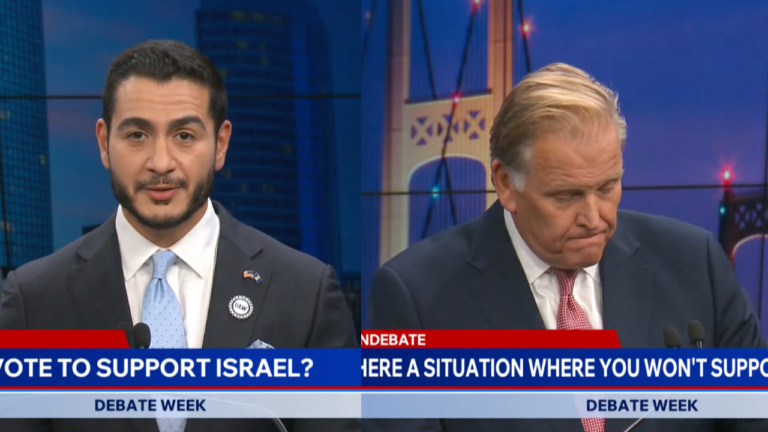
Michigan’s first U.S. Senate debate erupted into an unusually bitter confrontation Thursday as Democrat Abdul El-Sayed and Republican Mike Rogers traded personal accusations, clashed over Donald Trump’s policies, and continued arguing even when the cameras were supposed to be taking a break.
And the moderator had apparently never seen anything quite like it.
The October 8 debate in Grand Rapids was supposed to give Michigan voters a chance to compare two candidates competing for one of the most consequential Senate seats in the country. Instead, it became an extraordinary display of how deeply Trump’s presidency has divided the political landscape — including Republicans who are now trying to distance themselves from some of his most controversial decisions.
El-Sayed wasted little time making that contradiction central to his argument.
(WATCH THE VIDEO BELOW)
The Democratic nominee accused Rogers of being a political “sock puppet” for Trump, challenging the former congressman’s claim that he would exercise independent judgment in Washington.
Rogers fired back by attacking El-Sayed’s credibility, accusing him of misrepresenting his professional record and calling him a “conman.”
The exchanges became so contentious that moderator Rick Albin repeatedly struggled to keep the candidates focused.
At one point, Albin told the candidates that he would like to participate in the debate, too.
But the most remarkable revelation came when he described what happened during a commercial break.
“In 30 years of doing debates, I’ve never seen it continue during the commercial. But it did,” Albin said.
That single observation captured the intensity of a confrontation that had been building for weeks.
The candidates were not simply disagreeing about taxes or healthcare. They were fighting over political credibility, loyalty to Trump, the cost of living, and the direction of American foreign policy.
And Rogers entered the debate carrying a particularly complicated political message.
Although Trump has endorsed the Republican nominee, Rogers has recently broken with the president on two significant issues: the war involving Iran and tariffs on Canada.
Those disagreements are especially consequential in Michigan, where manufacturing jobs, cross-border trade, and rising household costs have become central concerns.
Just one day before the debate, Rogers released a campaign advertisement calling for an end to Trump’s tariff dispute with Canada.
The Republican argued that Canada is not America’s enemy and that the trade conflict should end.
It was a striking position for a candidate seeking the support of a president who has made tariffs a defining part of his economic agenda.
And it was not Rogers’ only recent departure from the White House.
He had also called for a quick end to the Iran war, warning about its consequences as Americans face higher fuel and grocery prices.
During Thursday’s debate, Rogers repeated his position that the conflict needed to end.
He also said he had contacted the White House to push for a trade agreement with Canada.
For El-Sayed, those reversals provided an opening to challenge Rogers’ independence.
The Democrat had already accused his opponent of supporting Trump’s trade policies before changing course as the election approached.
Rogers, meanwhile, argued that his relationship with the president could help him secure better outcomes for Michigan.
That disagreement exposed a central question running through the debate: whether a Republican candidate can benefit from Trump’s endorsement while openly challenging some of the administration’s major policies.
The conflict became even more personal because Trump himself had entered the race with a provocative attack on El-Sayed just hours before the debate.
In a late-night Truth Social post, Trump referred to the Democratic nominee as “Mohammed,” invoked jihad, and labeled him a “Terrorist Sympathizer.”
The accusation was directed at an American-born physician and former public health official whose parents immigrated from Egypt.
Trump offered no substantiated evidence for the inflammatory characterization.
El-Sayed responded by arguing that the president’s attack was about more than his candidacy.
“He’s not just attacking me. He’s attacking all of us,” the Democrat wrote, accusing Trump of using his name and religion to distract from the effects of the administration’s policies.
The exchange added another layer of tension to an already combative Senate contest.
Republicans have repeatedly targeted El-Sayed’s progressive positions, his views on foreign policy, and his associations with controversial political figures.
El-Sayed has sought to redirect attention toward the everyday concerns of Michigan residents, including healthcare, affordability, and economic security.
Those differences were on display during the debate.
One of the most contentious exchanges concerned American support for Israel and the ongoing conflict involving Iran.
Asked whether he would support sending weapons to Israel if the country were attacked, El-Sayed said he did not want American tax dollars subsidizing wars abroad.
When pressed to identify whether Iran or Israel represented the greater danger, he rejected the premise of the question and argued that both countries had demonstrated dangers in different ways.
The answer highlighted a genuine policy divide.
Rogers challenged El-Sayed’s foreign policy judgment, while El-Sayed emphasized his opposition to using American public money to support overseas conflicts.
The candidates also disputed immigration enforcement.
Rogers defended the broader role of Immigration and Customs Enforcement while criticizing aspects of the agency’s operations in Minnesota earlier this year.
He acknowledged that some enforcement actions had been handled inappropriately.
For a Republican candidate supported by Trump, even that limited criticism represented another departure from the administration’s usual defense of its immigration policies.
El-Sayed, who has advocated major changes to immigration enforcement, argued for a different approach while maintaining that the country must have secure borders.
Healthcare and household costs provided further points of disagreement.
El-Sayed has advocated Medicare for All, while Rogers argued that the proposal would threaten private insurance and impose substantial costs.
On energy prices, El-Sayed said policymakers should consider stronger intervention during a period of exceptionally high gasoline and diesel costs, including holding energy companies accountable.
Rogers emphasized the economic pressures facing Michigan families and businesses, including the state’s manufacturing challenges and high household expenses.
These were substantial policy disagreements that voters will have to weigh.
But the broader spectacle was impossible to separate from the political environment surrounding the debate.
Trump had personally attacked the Democratic nominee. His preferred Republican candidate was openly distancing himself from parts of Trump’s agenda. And the two candidates were so determined to challenge one another that their argument continued after the broadcast temporarily stopped.
It was hardly the controlled, carefully rehearsed exchange that political campaigns generally prefer.
The stakes extend far beyond Michigan.
The state is choosing a successor to retiring Democratic Senator Gary Peters, and the contest is receiving national attention because control of the Senate is at issue in November’s midterm elections.
Rogers previously came close to winning a Michigan Senate seat in 2024, losing to Democrat Elissa Slotkin by fewer than 20,000 votes.
El-Sayed emerged from a closely contested Democratic primary and has since worked to unite voters across a coalition that includes both progressive activists and more moderate Democrats.
Former President Barack Obama is scheduled to campaign with him in Detroit later this month, underscoring the national importance of the contest.
Thursday’s debate showed how sharply the candidates differ on policy and political identity.
It also showed the difficulties facing Republicans who must decide how closely to align themselves with Trump as his administration’s decisions generate controversy.
Rogers wants voters to believe he can work with the president while opposing him when Michigan’s interests require it.
El-Sayed wants voters to scrutinize that promise against Rogers’ record of support for Trump.
Neither argument can be settled by a heated exchange alone.
But the intensity of their first confrontation revealed how much both candidates believe is at stake.
The moderator tried to maintain order. The candidates kept attacking. And even a commercial break failed to bring the argument to a halt.
For Michigan voters, the debate offered a preview of the political fight ahead — one in which Donald Trump remains a central figure, even when he is nowhere near the stage.
And with Election Day approaching, the confrontation between Abdul El-Sayed and Mike Rogers is unlikely to become any less contentious.
WATCH: The Full Michigan Senate Debate (BELOW this video is The Heated Exchange Between Abdul El-Sayed and Mike Rogers )
WATCH: The Heated Exchange Between Abdul El-Sayed and Mike Rogers
The confrontation that became one of the most talked-about moments of their first Senate debate.
About the Author