Donald Trump has made no secret of his love for gold. From the gilded decorations of his properties to the golden touches inside the White House, the president has developed a rather unmistakable aesthetic.
Now a Danish artist has given him a golden tribute of an entirely different kind.
And this one comes without any clothes.
(PICTURES BELOW)
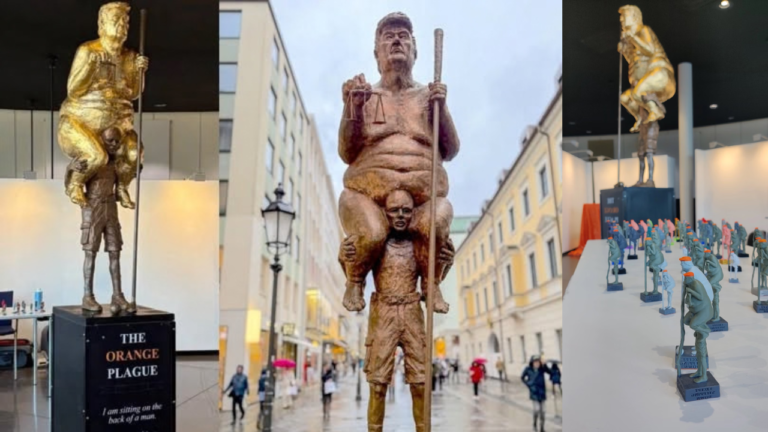
A towering sculpture depicting a completely naked Trump, covered in 23-carat gold leaf, has gone on display inside the European Parliament building in Strasbourg, France.
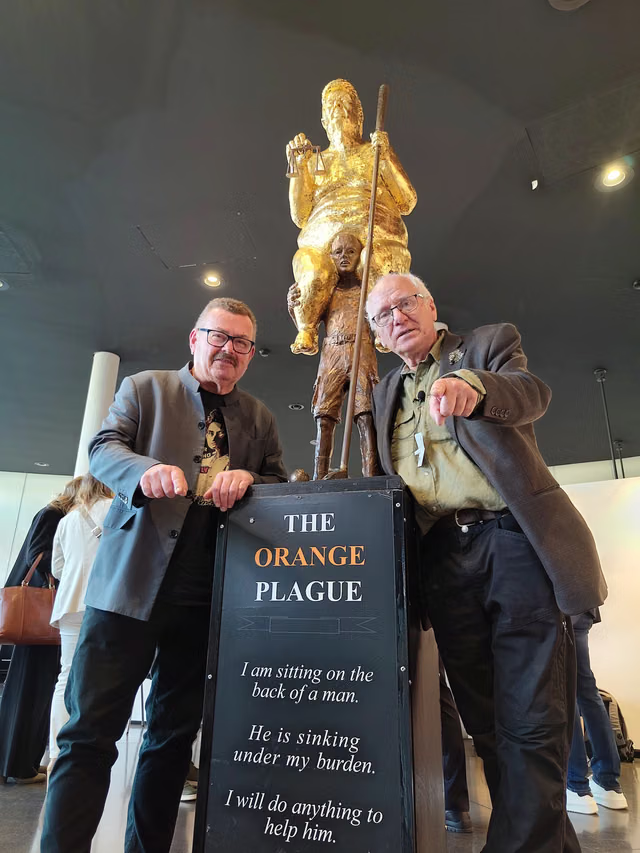
The nearly nine-foot-tall artwork, titled The Orange Plague, was created by Danish sculptor Jens Galschiøt. It depicts the president perched on the shoulders of a much smaller, struggling man.
Trump holds the scales of justice in one hand and a golf club in the other, while a globe-shaped golf ball rests below.
But the real message is written beneath the statue.
Its inscription describes a powerful figure who claims to want to help the man carrying him — while refusing to get off his back.
It is a pointed commentary on power, inequality and the burdens that political leaders can place on others.
And Galschiøt has made absolutely no attempt to hide whom he is criticizing.
The artist says Trump poses a serious threat to international cooperation, democratic values and efforts to address climate change.
The sculpture draws inspiration from Hans Christian Andersen’s famous fairy tale The Emperor’s New Clothes, in which a vain ruler is persuaded that he is wearing magnificent garments that nobody wants to admit are invisible.
In the story, the emperor’s subjects remain silent until a child finally points out the obvious.
Galschiøt has taken that familiar tale and given it a distinctly modern political setting.
The gold covering the statue is no accident, either.
The artist says Trump’s enthusiasm for gilded surroundings helped inspire the design.
And unlike the flattering monuments Trump has celebrated, this sculpture uses gold to make its criticism more conspicuous.
The exhibition was arranged by Danish member of the European Parliament Per Clausen, who invited Galschiøt to display the work inside the parliamentary complex.
It is not an official declaration by the European Parliament as an institution, but an exhibition hosted by one of its members.
Clausen was asked whether he was concerned about Trump’s potential reaction.
He responded that a political leader who cannot tolerate a critical sculpture has no place on the world stage.
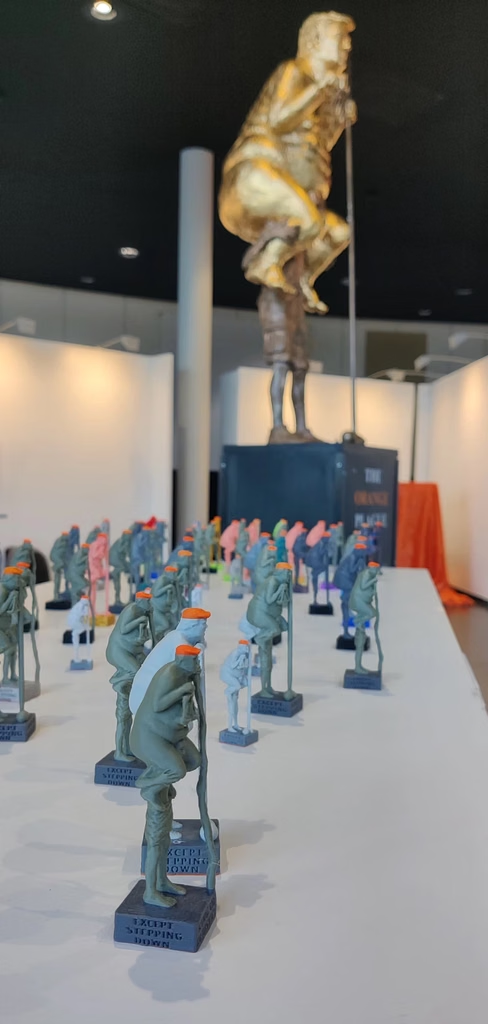
The statue has attracted attention from visitors, with miniature 3D-printed versions distributed as souvenirs.
Galschiøt has also made the design files publicly available, allowing people with access to a 3D printer to produce their own versions.
And Strasbourg is hardly the sculpture’s first stop.
The Orange Plague previously appeared during the COP30 United Nations climate conference in Brazil and at other European events. The artist plans to take it to the COP31 climate conference in Turkey.
Its appearance inside the European Parliament building, however, gives the work a particularly prominent political setting.
The sculpture is expected to remain on display in Strasbourg through Thursday, October 8.
As of the initial reports, Trump had not publicly commented on the exhibition, and no official White House response had been reported.
Online, some supporters of the president have criticized the display as disrespectful, while others have treated it as political satire.
The dispute reflects a familiar question about political art: whether provocative depictions of elected leaders are an important form of public criticism or an unnecessarily personal insult.
Galschiøt clearly intends the former.
For him, the naked figure is not simply an attempt to embarrass Trump. It is a statement about the president’s policies, international influence and the responsibilities of political power.
Still, the visual irony is difficult to miss.
A president famous for his affection for gold has become the subject of an enormous golden monument in one of Europe’s most important political buildings.
Only this time, the artist isn’t offering admiration.
He’s offering a warning.
About the Author