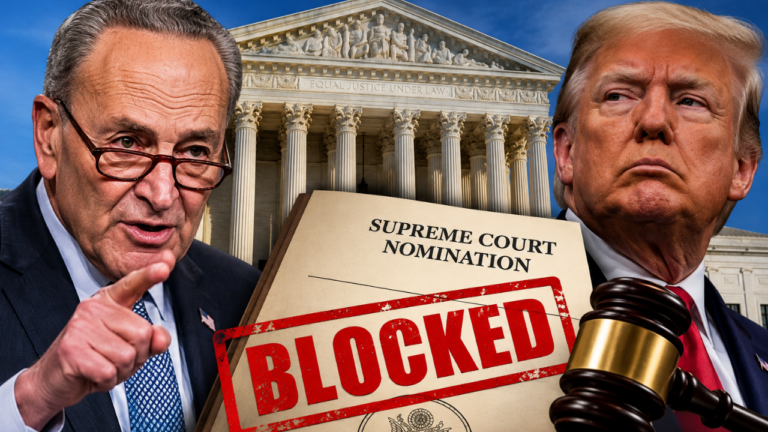
Senate Democrats are signaling that Donald Trump could run straight into a wall on judicial nominations if Democrats take control of the Senate this November — including if a vacancy opens on the Supreme Court.
Senate Minority Leader Chuck Schumer made clear that control of the federal courts is part of the stakes Democrats see in the battle for the Senate.
“The bottom line is: One of the reasons we want to do everything we can to take back the Senate is not let Trump put such horrible justices — MAGA justices — on the Supreme Court and the lower courts,” Schumer told NBC News.
And Schumer isn’t alone.
Sen. Richard Blumenthal of Connecticut, a senior Democrat on the Senate Judiciary Committee, indicated that another Trump Supreme Court nominee would face extraordinarily long odds in a Democratic-controlled Senate.
“Well, given the history of Trump nominees, I think it is slim to none that we would support a nominee from this administration,” Blumenthal said.
He argued that Democrats have already seen enough from Trump’s judicial appointments to know what another nominee could look like.
Then Sen. Ruben Gallego of Arizona made the strategy even more explicit.
“We’ve got to do exactly what McConnell did to us,” Gallego said.
That’s a reference Democrats haven’t forgotten.
In 2016, then-Senate Majority Leader Mitch McConnell refused to hold confirmation proceedings for President Barack Obama’s Supreme Court nominee Merrick Garland after Justice Antonin Scalia died in February — leaving the vacancy open until after the presidential election.
Donald Trump ultimately filled that seat with Neil Gorsuch.
Four years later, Republicans took a dramatically different approach after Justice Ruth Bader Ginsburg died just weeks before the 2020 presidential election.
With Trump still in the White House, the Republican-controlled Senate confirmed Amy Coney Barrett only days before voters went to the polls.
Trump ultimately appointed three Supreme Court justices during his first term — Gorsuch, Brett Kavanaugh and Barrett — helping create the Court’s current 6-3 conservative majority.
Now Democrats are openly discussing whether they should use control of the Senate to prevent Trump from adding another justice.
The issue has suddenly become more immediate because of renewed attention surrounding Justice Samuel Alito.
Alito, 76, acknowledged in a rare CBS News interview that he considered retiring at the end of the Court’s previous term.
“I thought about it,” Alito said, explaining that retirement is something he believes someone his age has to consider every term.
But Alito ultimately decided to stay.
He said he believed he could still make a valuable contribution to the Court and rejected the idea that calculations about which political party controls the White House should determine when a justice retires.
That means there is no current Supreme Court vacancy — and Alito has not announced plans to leave.
But his comments have highlighted just how consequential control of the Senate could become.
Under the Constitution, a president nominates Supreme Court justices, but confirmation requires the Senate.
If Democrats take control of the chamber and a Supreme Court seat becomes vacant during the final two years of Trump’s term, they would possess enormous leverage over whether his nominee ever reaches the bench.
And at least some Democratic senators are now saying publicly that they are prepared to use it.
After years of bitter battles over Garland, Gorsuch and Barrett, Democrats are making clear that the next Supreme Court vacancy could trigger another major confrontation between the White House and the Senate.
This time, however, they may be the ones holding the gavel.
About the Author