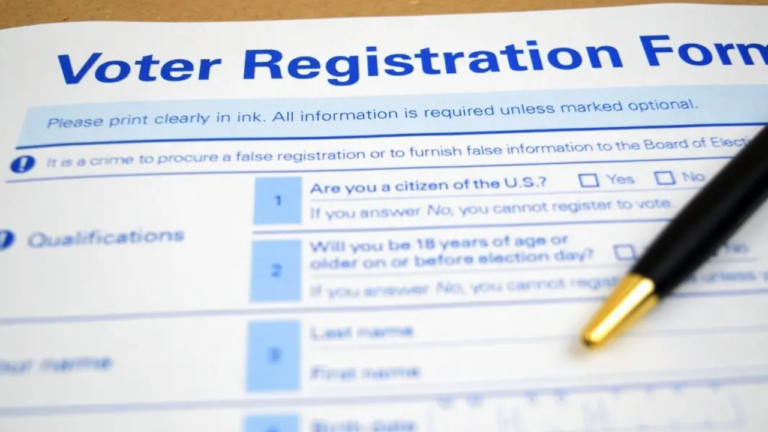
Donald Trump’s White House is pushing federal agencies to accelerate an extraordinary review of voter-registration records across nearly the entire country just weeks before the midterm elections.
And an internal government email obtained by Reuters offers a rare glimpse at how extensive the operation has become.
The Department of Homeland Security has obtained voter rolls from at least 47 states as federal officials search for noncitizens who may have registered to vote.
The effort has a name:
The “Unlawful Voter Initiative.”
And according to Reuters, DHS has surged hundreds of officers from across the federal security and immigration apparatus to work on it in recent months.
But perhaps the most striking revelation concerns the White House itself.
Reuters reviewed a September 1 internal DHS email that it says shows the White House is helping direct the effort and pushing agencies to make faster progress.
At one point, the email says a DHS official had offered to escalate problems directly to the White House chief of staff if officials couldn’t get “forward progress.”
The current White House chief of staff is Susie Wiles.
The administration says the objective is election integrity.
The White House told Reuters that every case involving potential noncitizen voting would be pursued, while DHS said its investigative work is being conducted professionally and legally and described the effort as important to ensuring confidence in election results.
The White House also publicly maintains an election-integrity portal documenting lawsuits, investigations and prosecutions involving voter rolls and alleged noncitizen voting.
But Reuters uncovered another element of the operation that has election experts and officials concerned.
DHS is supplementing voter-roll information with data purchased from a commercial data broker.
That can give investigators information not contained in publicly available voter files.
The concern is what happens when different databases don’t match perfectly.
Officials and experts interviewed by Reuters warned that inaccurate or mismatched commercial information could result in American citizens being mistakenly flagged as potential noncitizen voters — and potentially subjected to further investigation or detention.
And the scale matters.
There are roughly 170 million registered voters in the United States.
Reuters separately found that states may have mistakenly added more than 30,000 noncitizens to voter rolls since 2000 because of software and clerical errors.
But it was unclear how many of those people actually voted, and experts told Reuters the numbers were far too small relative to the total electorate to affect election outcomes.
Actual federal prosecutions for noncitizen voting have historically been rare.
A Reuters review found only 129 people had been charged under the federal “Voting by Aliens” statute from its enactment in 1996 through July 2026.
The Trump administration has sharply accelerated enforcement recently, however.
At least 20 additional people have been charged under the statute in recent months.
The voter-roll initiative has already generated legal questions at the state level.
Virginia Attorney General Jay Jones recently demanded answers from DHS after a whistleblower alleged federal employees had improperly accessed Virginia voter information while searching for potential noncitizens.
Jones said Virginia law restricts access to the state’s voter lookup tools and questioned whether federal officials had obtained protected information without authorization.
DHS had not responded to AP’s request for comment at the time of that report.
And there is another unresolved question:
How did DHS obtain voter rolls from all 47 states?
Reuters reports that this remains unclear.
Since Trump returned to office, his administration has sought unredacted voter-registration records from nearly every state as part of a broader push to identify noncitizens and alleged voting irregularities.
The federal government has a legitimate role in enforcing federal election laws.
But American elections are highly decentralized, and states traditionally hold primary responsibility for administering them.
That makes the scale, timing and White House involvement revealed by Reuters particularly significant as November approaches.
The administration says it’s looking for unlawful voting.
Critics and some election officials are raising questions about federal authority, data accuracy and the risk that eligible American voters could be wrongly flagged.
And now an internal DHS email has revealed just how far the operation has already spread:
At least 47 states. Hundreds of federal officers. And pressure from the White House to move faster.
About the Author