
The European Union just opened the door to an extraordinary new relationship with Canada — one that would have been difficult to imagine only a short time ago.
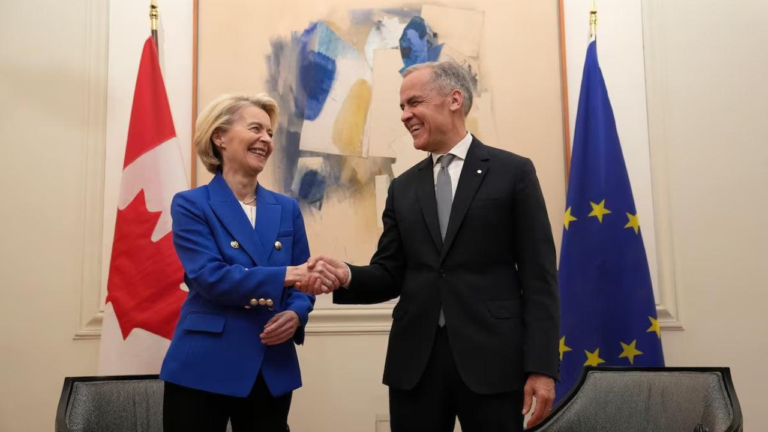
European Commission President Ursula von der Leyen announced Wednesday that she wants Canada to become the European Union’s first-ever “associate member,” unveiling the proposal with Canadian Prime Minister Mark Carney sitting inside the European Parliament in Strasbourg.
The reaction was immediate.
(Watch the video below.)
European lawmakers rose for a standing ovation before von der Leyen walked over and embraced Carney.
“We must urgently reimagine our partnerships,” von der Leyen told the chamber.
Then came the announcement.
She said she wanted to work with Carney on “opening the door for Canada” to become the first associate member of the European Union.
It would be unprecedented.
The European Union currently has no formal category of “associate membership” written into its treaties, meaning the exact rights, obligations and structure of such an arrangement would have to be negotiated.
So Canada is not joining the EU today.
But the political significance of what happened in Strasbourg is difficult to miss.
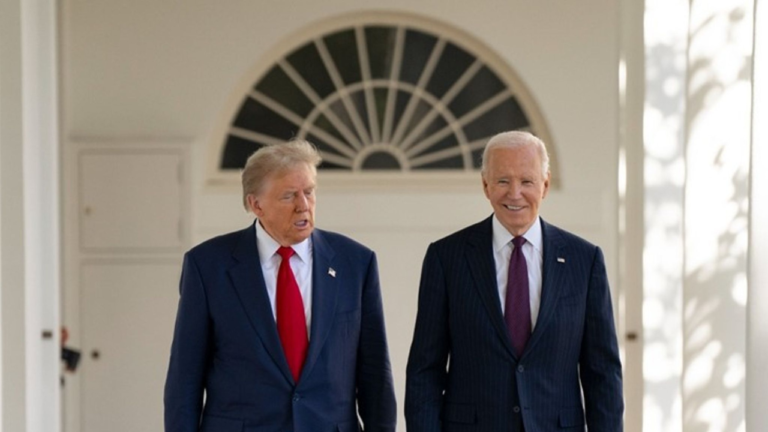
Canada and the European Union are openly exploring a relationship substantially deeper than their existing trade agreement — at the same time that Ottawa’s historically close relationship with Washington has been badly strained by President Donald Trump’s trade policies.
Trump’s tariffs and increasingly difficult relationship with Canada have pushed Carney’s government to accelerate efforts to diversify its economic and strategic relationships.
Europe is now offering an extraordinary opportunity to do exactly that.
Von der Leyen outlined an ambitious agenda stretching far beyond ordinary trade.
She said Europe and Canada would move from their existing CETA trade agreement toward what she called an “Alliance for the Future,” creating a shared space focused on prosperity and economic security.
The two sides would pursue deeper cooperation in advanced manufacturing and technology.
They would work toward integrating their defense industrial bases.
They would expand cooperation in energy, critical minerals and batteries.
And they would pursue partnerships involving artificial intelligence, quantum computing, cybersecurity and the Arctic.
“This is not a partnership against anyone else, but for our common strength,” von der Leyen said.
That distinction matters.
Neither von der Leyen nor Carney presented the proposal as an anti-American alliance.
But the geopolitical backdrop is impossible to ignore.
For generations, Canada’s economic relationship with the United States has dwarfed virtually every other international partnership.
Roughly seven out of every ten dollars of Canadian goods exports still go to the United States.
That dependence has become increasingly uncomfortable for Ottawa as its relationship with Washington has deteriorated.
Carney has responded by looking aggressively toward Europe.
Canada has already expanded cooperation with the EU on defense and security, and on Wednesday it also formally applied to join the British-led Joint Expeditionary Force, a European rapid-response military coalition.
Now Europe is proposing something even larger.
The idea is still at an early stage.
Von der Leyen cannot unilaterally create a new category of EU membership. European governments would have to agree on what “associate membership” actually means, and Reuters reported Wednesday that some European diplomats are already questioning how the unprecedented arrangement would work.
Carney has also previously made clear that Canada is not seeking conventional full membership in the European Union.
What Ottawa wants is something new.
And that is precisely what Europe now appears willing to discuss.
Von der Leyen said Europe and Canada share democratic values and increasingly similar strategic interests.
“We share one ocean, one set of values, one way of seeing the world,” she told Carney.
For Washington, the larger story is not that Canada suddenly became European.
It didn’t.
The story is that one of America’s closest allies is actively building alternatives to its historic dependence on the United States — and Europe is responding by offering Canada a relationship that has never previously existed.
Trump has argued that his aggressive trade policies will strengthen the United States and force other countries to negotiate on Washington’s terms.
Canada’s response is now taking shape in Strasbourg.
Instead of moving closer to Washington, Ottawa is exploring deeper economic, technological and defense integration with Europe.
And on Wednesday, the president of the European Commission opened a door that had never existed before.
About the Author

Little by little Trump is painting himself into a smaller and tighter corner. Like Adolf Hitler did back in the day. Amen?