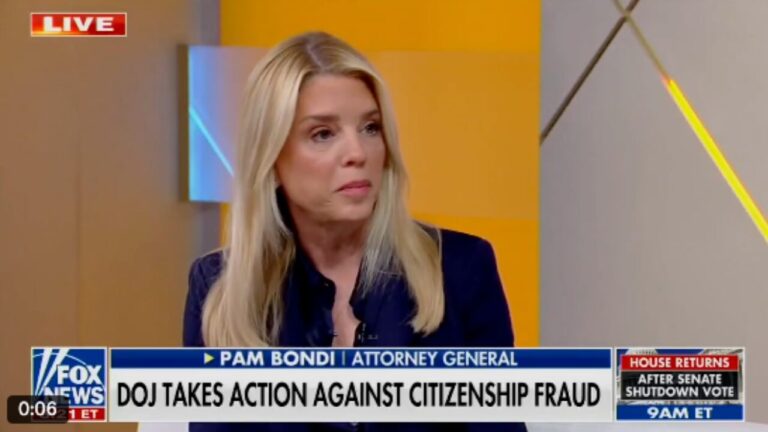
U.S. Attorney General Pam Bondi is now getting a lot of criticism for saying that being a U.S. citizen is a “privilege, not a right.” This came after two people had their citizenship taken away because they lied on their application forms. According to the International Business Times, her remarks also led to debates about constitutional rights.
During an interview with Fox News about citizenship decisions, Bondi said, “Being a citizen in our country is a privilege, not a right.
And President Donald Trump is going to have everyone in this country who deserves to be here, who is a citizen.” After the interview, Bondi repeated her position on X, writing, “American citizenship is a sacred privilege — not a cheap status that can be obtained dishonestly.” She also said that “Today’s denaturalization actions reflect this Department of Justice’s ongoing efforts to strip citizenship from people who conceal crimes or defraud the American people during the immigration process.”
The idea that citizenship is a privilege, not a right, has already caused a lot of anger.
Many people argue that U.S. citizenship is actually a constitutional right. The first sentence of the 14th Amendment clearly says that “all persons born or naturalized in the United States, and subject to the jurisdiction thereof, are citizens of the United States.” Treating rights as privileges implies they can be taken away anytime, which goes against the idea of constitutional protection.
Reactions on X were especially strong.
One post compared Bondi’s comments to the revocation of citizenship for Jewish people in Nazi Germany, which was a serious and terrifying event.
These comments come at a time when the Trump administration is trying to change immigration rules and how citizenship is defined.
On January 20, 2025, Trump signed an executive order called Protecting the Meaning and Value of American Citizenship. This order told federal agencies to stop recognizing citizenship for children born in the U.S. if neither parent is a U.S. citizen or a lawful permanent resident.
The legality of this executive order is already being questioned.
The U.S. Supreme Court is set to hear arguments about it, and some lower courts have already stopped the policy, saying it breaks the 14th Amendment and federal law. It’s also important to know that denaturalization, while getting more attention now, has been very rare in the U.S. — with only about 11 cases reported each year.
Bondi: "Being a citizen in our country is a privilege, not a right. And Donald Trump is going to have everyone in this country who deserves to be here who is a citizen." pic.twitter.com/UHSJL7xdT1
— Aaron Rupar (@atrupar) March 27, 2026
About the Author