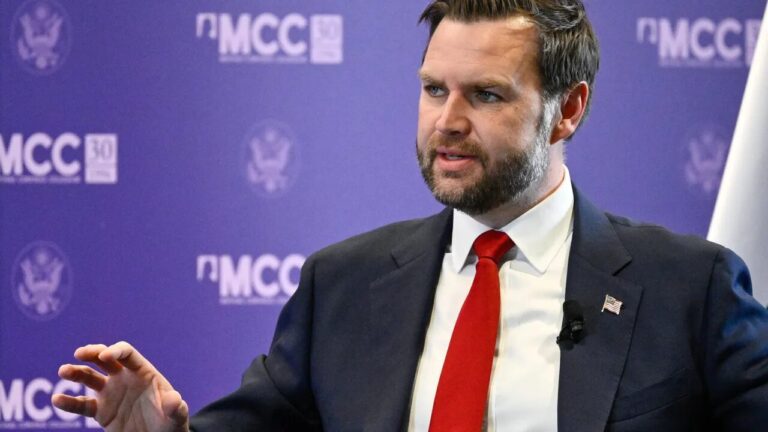
Vice President JD Vance came out of a long negotiation meeting with Iranian leaders around 6:30 a.m. on Sunday in Islamabad, Pakistan. He told reporters that the two sides did not reach an agreement to end the war, because Iran chose not to accept the U.S. terms.
Vance was with special envoy Steve Witkoff and Jared Kushner, who is President Donald Trump’s son-in-law and adviser.
He said the “good news” was that the U.S. and Iran had “a number of substantive discussions” about ending the war.
“The bad news is that we have not reached an agreement,” Vance said.
“And I think that’s bad news for Iran, much more than it’s bad news for the United States of America.”
He added, “So we go back to the United States having not come to an agreement.
We’ve made very clear what our redlines are, what things we’re willing to accommodate them on, and what things we’re not willing to accommodate them on — and we’ve made that as clear as we possibly could. And they have chosen not to accept our terms.”
In particular, Vance said the U.S. required an “affirmative commitment” that Iran would not seek a nuclear weapon.
He told reporters that the three American representatives were “quite flexible” in what they were willing to do to get a deal done in Pakistan, but that Iran did not bring the same attitude.
“The president told us, you need to come here in good faith and make your best effort to get a deal,” Vance said.
“We did that, and unfortunately, we weren’t able to make any headway.”
Vance spoke to reporters shortly after wrapping up what was reported as a 15-hour meeting; he said it was even longer than that, lasting 21 hours.
He praised Pakistani Prime Minister Shehbaz Sharif and Field Marshall Syed Asim Munir for organizing the summit, saying “whatever shortcomings” there were in the meeting were not because of them.
The American delegation met with Iranian Foreign Minister Abbas Araghchi and Mohammad Bagher Ghalibaf, the speaker of Iran’s Parliament.
Vance became the highest-ranking American politician to meet face-to-face with leaders from Iran’s theocratic regime since the 1979 Islamic Revolution.
The New York Times reported shortly before the meeting concluded that opening the Strait of Hormuz remains a “sticking point,” according to two unnamed senior Iranian officials who spoke to the paper.
Earlier in the day, Trump told reporters at the White House on Saturday afternoon he wasn’t too worried about how the negotiations were going.
“I’m getting a lot of reports.
They’ve been meeting for many hours, as you probably have noticed,” Trump said. “We’ll see what happens. Look, regardless, we win. Regardless what happens, we win. We’ve totally defeated that country, and so let’s see what happens. Maybe they make a deal, maybe they don’t. It doesn’t matter. From the standpoint of America, we win.”
The meeting came a few days after Trump stopped his planned attacks on Iranian bridges and power plants about 90 minutes before his Tuesday night deadline.
The two sides agreed to a two-week ceasefire, and Vance flew to Pakistan to try and finalize a deal.
Trump said a “golden age” for the Middle East could be on the horizon soon after the ceasefire was announced, and said the U.S. would be “hangin’ around” to make sure the Strait of Hormuz remained open.
But the Strait remained a choke point, even after the deal was agreed to.
About the Author