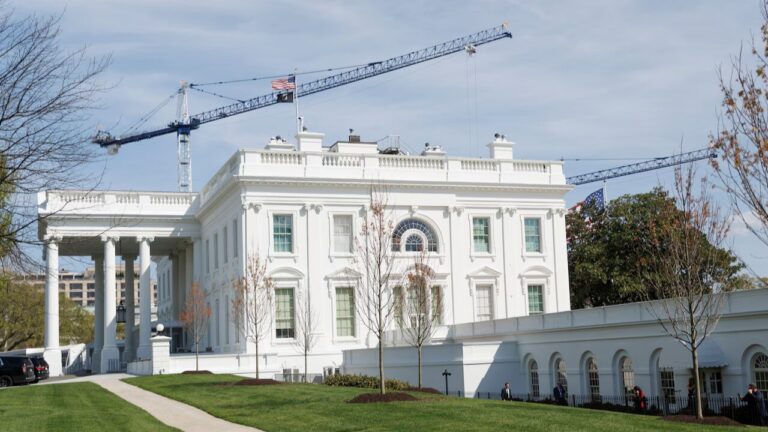
WASHINGTON, March 31 (Reuters) – A U.S. judge said on Tuesday that President Donald Trump cannot build his planned $400 million ballroom on the site of the White House’s demolished East Wing without approval from Congress, stopping one of the Republican president’s most visible efforts to change the seat of American power.
U.S. District Judge Richard Leon agreed with a request from the National Trust for Historic Preservation, a nonprofit group that sued Trump, claiming he went beyond his authority by tearing down the historic East Wing and starting construction on the new building.
Leon, who was appointed by Republican former President George W. Bush, put the 90,000-square-foot ballroom project on hold while the lawsuit continues.
“In short, unless and until Congress supports this project through a law, construction has to stop!”
Leon wrote in his order, referring to the Trump administration.
Leon gave the Trump administration 14 days to appeal his decision.
He also said the order does not affect “construction needed to keep the White House safe.” The Justice Department appealed the order to the U.S. Court of Appeals for the District of Columbia Circuit shortly after it was issued.
Trump posted on his social media site Truth Social, calling the National Trust a group of “left-wing lunatics” and saying his ballroom is “under budget, ahead of schedule, built at no cost to taxpayers, and will be the finest building of its kind anywhere in the world.”
Carol Quillen, president and CEO of the National Trust, welcomed Leon’s ruling in a statement.
“This is a win for the American people on a project that will forever impact one of the most beloved and iconic places in our nation,” Quillen said.
Trump has promoted the ballroom as a key addition to the White House and a lasting symbol of his presidency.
Leon’s ruling is a setback for Trump’s Justice Department, which opposed the injunction and argued that the ballroom is a permissible change that modernizes the White House grounds.
The National Trust sued Trump and several federal agencies in December after the administration demolished the East Wing, originally built in 1902 and expanded during Franklin Roosevelt’s presidency, to make way for the ballroom.
The group claims the president and the National Park Service, which manages the White House grounds, did not have the authority to tear down the historic structure or build a major new facility without clear congressional approval.
The National Trust is also involved in another lawsuit challenging the administration’s plans to renovate the Kennedy Center performing arts venue in Washington.
The administration says the ballroom will modernize infrastructure, improve security, and reduce strain on the Executive Mansion, which often uses temporary outdoor structures for big events.
Officials say the project is fully funded by private donors.
“STEWARD OF THE WHITE HOUSE”
In his order, Leon said no federal law even comes close to giving the president the power to demolish the East Wing and build a ballroom with private funds.
“The President of the United States is the steward of the White House for future generations of First Families.
He is not, however, the owner!” Leon wrote.
When asked about the ruling at an Oval Office event on Tuesday, Trump told reporters Leon was “totally wrong” about the need for congressional approval.
“Many things have been built in the White House,” Trump said.
“They haven’t gotten congressional approval, especially when the money isn’t coming from taxpayers.”
A panel of the U.S. Commission of Fine Arts, made up entirely of Trump appointees, voted 6-0 in February to approve the design.
The ballroom is part of Trump’s larger effort to change Washington’s historic core, which also includes plans for a 250-foot (76-meter) arch and changes at the Kennedy Center.
On Thursday, the National Capital Planning Commission, one of two federal groups required to approve the ballroom, is set to hold a hearing and vote on the project’s building plans.
A spokesperson for the commission did not immediately respond to a request for comment.
About the Author