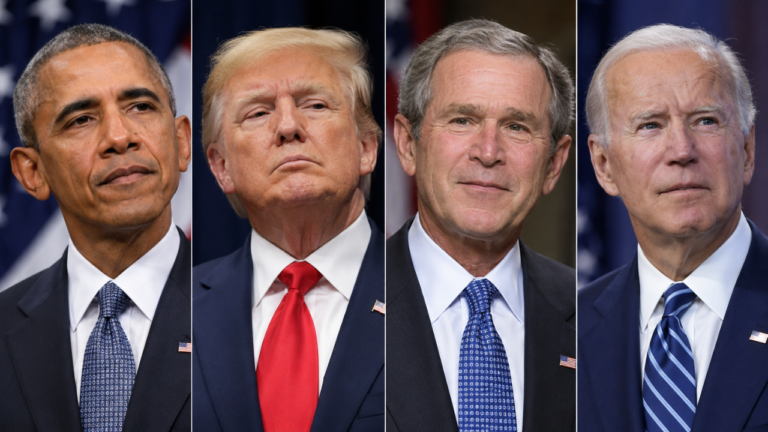
A new national poll conducted for Politico has revealed how Americans view the four presidents who have occupied the White House since 2001, highlighting Barack Obama’s enduring popularity and the deeply divided public response to Donald Trump.
The survey, conducted online by PF Global from November 7 to 10, asked 2,000 American adults to rank Barack Obama, Donald Trump, George W. Bush and Joe Biden from best to worst.
According to the published results, 51 percent of respondents selected Obama as their preferred president, compared with 28 percent who selected Trump, 16 percent who chose Bush and 5 percent who picked Biden.
Meanwhile, 52 percent of respondents placed Trump last, compared with just 8 percent who placed Obama last.
The survey was conducted shortly after the November midterm elections and carries a reported margin of error of two percentage points.
Obama’s popularity extends beyond Democratic voters
One of the most notable findings was Obama’s ability to attract support from Americans who voted for Trump in the 2024 presidential election.
According to Newsweek, 16 percent of those voters selected Obama as their preferred president. Among Trump voters who do not identify with the MAGA movement, that figure increased to 23 percent.
Obama’s popularity has endured nearly a decade after he left the White House in January 2017.
The former president remained active throughout the recent midterm election campaign, appearing at events supporting Democratic candidates in Texas, Ohio, Michigan and Georgia.
Todd Belt, director of the political management program at George Washington University, told Newsweek that Obama’s performance in the survey was “not particularly surprising.”
Belt pointed to Obama’s association with the country’s economic recovery following the Great Recession, a period that shaped much of his presidency and continues to influence perceptions of his legacy.
Obama also received substantial support from different ideological groups within the Democratic Party.
Among moderate Democrats, 76 percent selected Obama as their preferred president. That figure increased to 83 percent among progressive Democrats.
Trump’s political coalition shows significant divisions
The survey highlighted the extent to which public attitudes toward Trump remain polarized.
While 28 percent of all respondents placed Trump first, 11 percent ranked him second and 9 percent placed him third. More than half placed him last.
However, Trump’s support varied considerably depending on whether his voters identified with the MAGA movement.
Among MAGA Trump voters, 81 percent selected him as their preferred president.
That figure dropped to 42 percent among Trump voters who did not identify as MAGA. Within that group, 32 percent selected George W. Bush and 23 percent selected Obama.
Democratic respondents expressed substantially different views of Trump’s presidency.
Eighty-eight percent of progressive Democrats and 82 percent of moderate Democrats placed Trump last among the four presidents.
The findings illustrate the differences not only between Democratic and Republican voters but also among voters within Trump’s own political coalition.
Biden struggles to attract first-place votes
Former President Joe Biden received 5 percent of first-place votes in the survey.
However, 32 percent of respondents placed him second and 28 percent placed him third, while 34 percent ranked him last.
Progressive Democrats expressed more favorable views of Biden than some other groups, with 63 percent placing him second.
Among moderate Democrats, 12 percent selected George W. Bush as their preferred president, exceeding Biden’s share of first-place votes within that group.
Belt suggested that Biden’s public standing had been affected by the coronavirus pandemic and the inflation that followed.
“People don’t like inflation,” he said.
The political management expert also argued that Biden had remained in the political spotlight for too long and had not been prepared to transfer leadership when the opportunity arose.
The survey comes as Biden has released a new memoir, Promise Me, America, in which he defended his decision to pursue a second presidential term, describing it as an “obligation.”
George W. Bush receives less polarized responses
Former President George W. Bush received 16 percent of first-place votes, while 40 percent of respondents placed him second and 38 percent placed him third.
Only 7 percent ranked him last.
Unlike the more polarized responses surrounding Trump, Bush’s results were concentrated largely in the middle positions.
Bush also attracted support from voters who backed Trump in 2024 but did not identify with the MAGA movement.
Americans look ahead to 2028
The Politico survey also examined public expectations for the next presidential election.
Fifty-two percent of respondents said they expected Democrats to win the White House in 2028.
Among voters who supported Trump in 2024, 22 percent expected a Democratic victory, 60 percent expected Republicans to retain the presidency and 18 percent were uncertain.
Belt cautioned against assuming that the political dynamics of the recent midterm elections would necessarily determine the outcome of the next presidential race.
“It was a referendum on Donald Trump,” he said of the midterms, explaining that presidential elections tend to focus more heavily on the future.
The responses reflect voters’ expectations at the time of the survey rather than a prediction of the eventual election result.
Other surveys highlight similar political divisions
The Politico findings follow several other surveys examining public attitudes toward American presidents and their historical legacies.
An Elon University survey found that 29 percent of Republican respondents considered Trump the greatest president in American history, compared with 25 percent who selected Abraham Lincoln and 14 percent who selected George Washington.
Trump himself weighed in on presidential rankings in August, publishing his own assessment on Truth Social.
He placed himself alone in a category labeled “The Greatest,” while placing Obama, Biden and former President Jimmy Carter in a category labeled “Failures.”
A subsequent YouGov survey revealed significantly different assessments among the American public.
Thirty-one percent of respondents described Obama as a great president, while 35 percent characterized Biden as a failure.
Nearly half of respondents characterized Trump as a failure, according to reporting by National Security Journal.
Meanwhile, a separate Economist/YouGov survey conducted from November 9 to 11 placed Trump’s job approval rating at 32 percent, reportedly the lowest level recorded in that poll’s tracking.
Taken together, the surveys highlight the continuing influence of Obama on American political life and the sharply divided opinions surrounding Trump’s presidency.
Nearly a decade after leaving office, Obama continues to attract support extending beyond traditional Democratic constituencies, including a portion of the electorate that supported Trump in 2024.
The latest findings provide a snapshot of public attitudes toward the four presidents who have shaped American politics over the past quarter-century.
SOURCES
About the Author