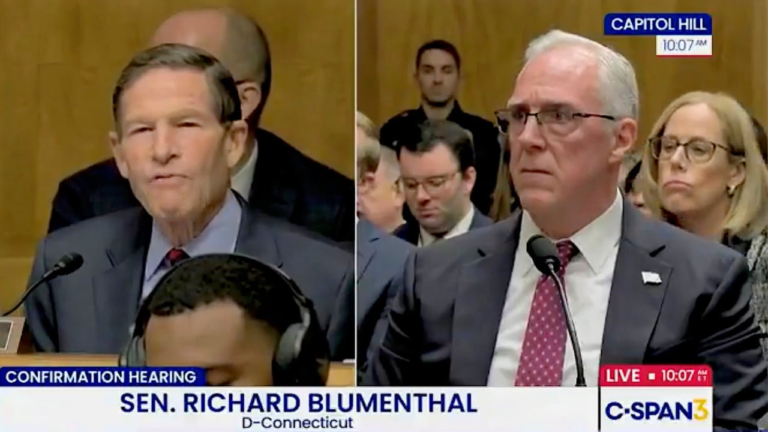
Senator Richard Blumenthal (D-CT) confronted several of President Donald Trump’s nominees during a Senate confirmation hearing Thursday, pressing them to answer two basic questions about American history — and repeatedly challenging their qualifications when they declined to respond directly.
The questions concerned who won the popular vote in the 2020 presidential election and whether the violence at the U.S. Capitol on January 6, 2021, constituted an attack.
The exchanges took place as Senate Republicans worked to advance administration nominees before Democrats assume control of the chamber in January.
Among those questioned was Michael LoSapio, a Palantir executive nominated to lead the Cybersecurity and Infrastructure Security Agency, commonly known as CISA.
The agency is responsible for protecting critical infrastructure, including systems supporting American elections.
Blumenthal began by asking LoSapio a straightforward question:
“Who won the popular vote in the 2020 presidential election?”
LoSapio declined to answer.
“I’m not going to answer the question about an election 6 years ago,” he replied.
Blumenthal immediately challenged the response, pointing to the responsibilities LoSapio would assume if confirmed.
“You’re in charge of election security, correct?” the senator asked. “You’re supposed to look at the facts, and you’re supposed to tell us the facts. And I’m asking you a factual question.”
Rather than identify Joe Biden as the winner of the 2020 popular vote, LoSapio offered another response.
“My only involvement in the 2020 election was voting for the president of the United States,” he said.
Blumenthal questioned whether the nominee’s refusal demonstrated a lack of independence and objectivity, qualities the senator argued were essential for someone overseeing election security.
When pressed again, LoSapio maintained his refusal.
“No, sir. I’m here to talk about the future,” he said.
Blumenthal responded with a direct assessment of the nominee’s suitability.
“You are disqualified from the position that you’ve been nominated to fill.”
But the exchange became even more contentious when Blumenthal turned to the events of January 6, 2021.
The senator asked whether the Capitol had been attacked that day.
LoSapio initially responded:
“I don’t know.”
When Blumenthal challenged that answer, LoSapio went further.
“No, I don’t believe there was an attack. No.”
Blumenthal reacted incredulously.
“Were you alive on the planet?”
The confrontation drew particular attention because the agency LoSapio hopes to lead plays a central role in protecting election infrastructure.
The January 6 attack occurred when a mob of Trump supporters breached the Capitol as Congress was preparing to certify Biden’s presidential victory.
More than 140 police officers were injured during the violence, and hundreds of participants were subsequently prosecuted.
LoSapio’s characterization of the event conflicts with the established record of what occurred.
Blumenthal was not finished questioning Trump’s nominees.
He also confronted Michael Chamberlain, nominated to lead the Office of Government Ethics, an agency tasked with overseeing ethical standards across the executive branch.
When asked who won the popular vote in 2020, Chamberlain responded:
“Joe Biden was the president for 4 years.”
Blumenthal repeated the question, seeking a direct answer about the election result.
Chamberlain again avoided naming the popular-vote winner.
“You know, that answer is really pathetic,” Blumenthal replied.
The senator then questioned Chamberlain about whether the Capitol had been attacked on January 6.
Chamberlain acknowledged that some people had engaged in inappropriate behavior but stopped short of directly answering the question.
Blumenthal challenged how the nominee could serve as the federal government’s chief ethics official while declining to answer what the senator considered a basic factual question.
“Do you really want this job?” he asked.
The senator also raised questions about potential conflicts of interest involving Trump’s financial connections to World Liberty Financial and reported investments linked to the United Arab Emirates.
Chamberlain did not provide the direct assessment Blumenthal sought.
Another nominee, Maria D’Avanzo, Trump’s choice for inspector general of the General Services Administration, faced similar questioning.
D’Avanzo repeatedly said she did not know who had received the most votes in the 2020 presidential election.
Blumenthal challenged her response.
“Why don’t you just say, ‘I won’t answer that question’?” he asked.
D’Avanzo also described January 6 as a chaotic protest rather than explicitly calling it an attack.
However, not every nominee refused to acknowledge the election result or the Capitol violence.
Mark Priebe, nominated for an inspector general position at the Education Department, directly identified Joe Biden as the winner of the 2020 popular vote.
Robert Steinau, nominated to serve as NASA’s inspector general, also acknowledged Biden’s victory and described January 6 as an attack.
Blumenthal contrasted those responses with D’Avanzo’s answers, arguing that a willingness to state established facts was a fundamental requirement for independent oversight positions. Government Executive+1
The questioning extended beyond executive branch appointments.
During a separate examination of four nominees for judgeships in Washington, D.C., Blumenthal asked whether any would acknowledge that Biden won the 2020 popular vote.
The nominees did not directly answer.
He then asked whether any would characterize the January 6 violence as an attack on the Capitol.
Again, the panel did not provide the direct response he requested.
Blumenthal challenged the nominees’ unwillingness to address the questions, emphasizing that judges are expected to demonstrate independence and respect for factual evidence.
The confrontations highlighted a broader debate surrounding the Trump administration’s appointment process and the independence of officials selected for positions involving government oversight, ethics and election security.
Republicans have argued that the president is entitled to nominate officials who support his administration’s priorities, subject to Senate confirmation.
Democrats have raised concerns about whether some nominees would act independently when their responsibilities require decisions that could conflict with the president’s political interests.
The LoSapio nomination has also encountered resistance beyond the Democratic caucus.
Republican Senator Thom Tillis and Democratic Senator Ron Wyden have indicated that they intend to place holds on his nomination, complicating efforts to advance it through the Senate. Nextgov/FCW+1
For Blumenthal, the hearing centered on a fundamental question: whether nominees for sensitive federal positions would acknowledge documented facts even when those facts might be politically uncomfortable.
His questioning produced a series of exchanges in which several nominees declined to provide direct answers about the 2020 election and January 6.
The 2020 presidential election results are not in dispute. Joe Biden won both the popular vote and the Electoral College.
The January 6 attack on the Capitol is likewise extensively documented through court proceedings, congressional investigations and video evidence.
As the Senate considers the nominations, the exchanges have drawn attention to the standards of independence and factual judgment expected of officials entrusted with protecting federal institutions.
And Blumenthal’s questioning ensured that those issues would be part of the public record before senators decide whether the nominees should receive confirmation.
SOURCES
CyberScoop · The Daily Beast · Daily Kos · The Independent
About the Author