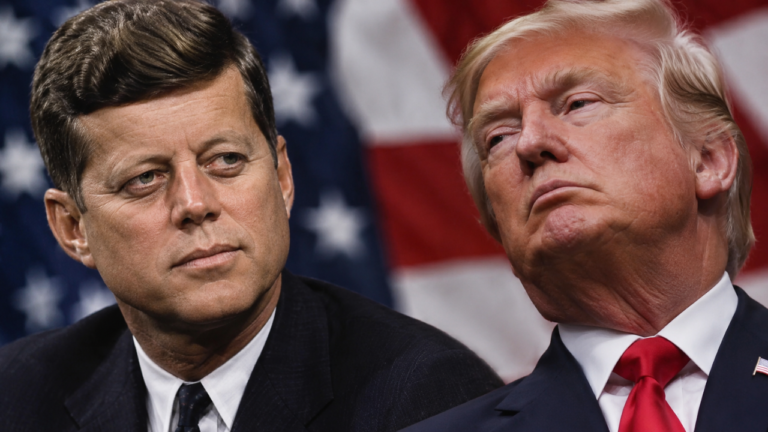
Nine members of the Kennedy family are moving to block Donald Trump’s proposed 250-foot triumphal arch near Arlington National Cemetery, warning that the towering monument could permanently damage the historic setting of President John F. Kennedy’s grave.
The family members filed a motion Tuesday to join existing litigation challenging the project, which critics have dubbed the “Arc de Trump.”
The proposed arch, decorated with golden angels and a flame, would stand between the Lincoln Memorial and Arlington National Cemetery, where JFK, his brothers Robert F. Kennedy and Edward M. Kennedy, and other members of the family are buried.
According to the family’s filing, the structure would “permanently cast a shadow over plaintiffs’ parents’ graves and the graves of servicemen and -women who made the ultimate sacrifice for this country.”
The Kennedys also argue that the arch would obstruct the historic view from JFK’s eternal flame across Memorial Bridge toward the Lincoln Memorial.
That sightline, the filing explains, was “designed to represent the unification of the nation following the Civil War.”
Blocking it, the family contends, would destroy “an essential element of the gravesite’s design.”
Among those opposing the project are Rory and Maxwell Kennedy, children of Robert and Ethel Kennedy — and siblings of Trump’s Health Secretary, Robert F. Kennedy Jr.
The two issued a pointed statement explaining their opposition.
“A towering arch casting shadows across the graves of our father, mother and uncles, as well as the graves of so many who have served our country, would also cast a shadow over our democratic principles.”
The Kennedy family’s intervention adds to an already significant legal challenge involving veterans, a historian, the District of Columbia, Virginia and Arlington County.
Last Thursday, the National Capital Planning Commission approved the monument. But U.S. District Judge Tanya Chutkan subsequently issued a 14-day order temporarily blocking construction.
In her 33-page opinion, Chutkan raised concerns about congressional authorization, potential costs to surrounding jurisdictions and disruptions to traffic near the heavily visited site.
The family’s attorneys, Norman Eisen and Steve Jonas of the Democracy Defenders Fund, argued that a project of this scale cannot proceed without congressional approval.
“Only Congress has the constitutional power to authorize an intrusion of this magnitude,” they said.
The dispute comes amid broader controversy over Trump’s efforts to reshape prominent Washington landmarks, including his proposed White House ballroom and attempts to attach his name to the Kennedy Center.
But for the Kennedy family, the latest fight is about more than architectural design.
They argue that the monument threatens the solemn character of Arlington and a carefully preserved memorial honoring a president and generations of American service members.
The court has not issued a final ruling on the project’s legality, and the family’s concerns about its visual impact remain claims presented in the litigation.
Still, the newest challenge places Trump in direct opposition to members of one of America’s most prominent political families — including the siblings of a member of his own Cabinet.
And with Democrats preparing to take control of Congress in January, the question of whether lawmakers must authorize the project could become even more consequential.
About the Author