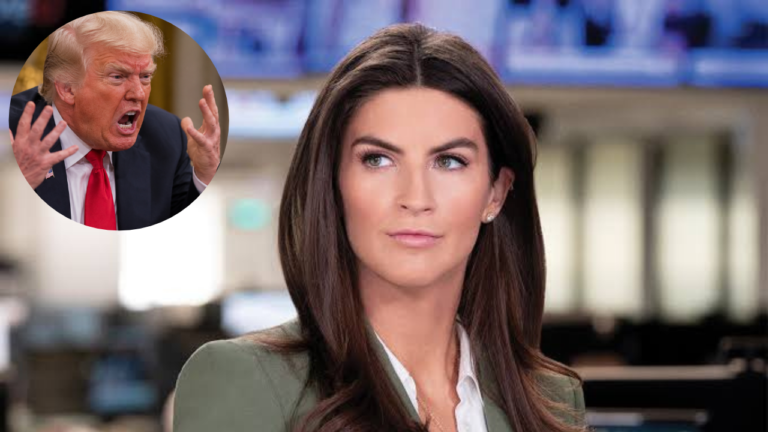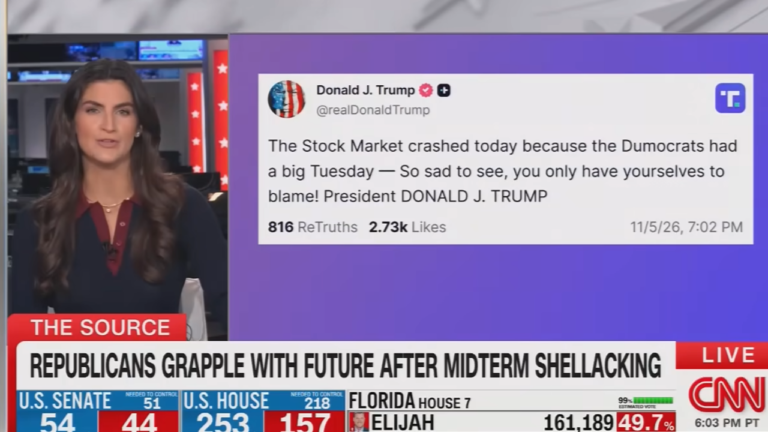
CNN’s Kaitlan Collins confronted President Donald Trump’s explanation for the Republican Party’s midterm election losses Thursday night, using footage of his own campaign speeches to highlight a contradiction in his post-election message.
On The Source, Collins questioned Trump’s attempt to blame voters for a stock market crash following Democrats’ projected victories, noting that the president had personally endorsed several Republican candidates who lost.
“Blaming the voters is certainly an interesting strategy, given it was the president whose policies the voters themselves blamed, and it was this president who personally backed a slew of candidates that lost in huge races,” Collins said.
She then played a montage of Trump enthusiastically supporting Republican Senate candidates, including Mike Collins in Georgia, Michael Whatley in North Carolina, Ken Paxton in Texas, Darline Graham in South Carolina and Mike Rogers in Michigan.
All five lost their races, according to the election results cited in the report.
“Well, that’s what the president said about those candidates who were on the ballot,” Collins remarked.
But the most revealing part of her segment came when she turned to Trump’s own explanation for the defeats.
In a Thursday Truth Social post, Trump insisted that his absence from the ballot was the reason Republicans had struggled.
“I just wasn’t on the ballot. If I were, we would have won in a landslide,” the president wrote.
Collins immediately pointed viewers toward what Trump had been telling his supporters before Election Day.
“But that’s not what the president told voters over and over and over again right before the election,” she said.
The CNN anchor then aired a second montage, this time showing Trump repeatedly encouraging his supporters to “pretend I’m on the ballot.”
The contrast was the central point of Collins’ report.
Before the election, Trump had encouraged voters to treat Republican races as though he were personally running. After the results, he argued that Republicans would have performed better if his name had actually appeared on their ballots.
Collins’ segment placed those statements side by side, allowing viewers to hear the difference for themselves.
The footage did not establish why individual voters made their choices. But it raised a direct question about Trump’s effort to separate himself from the results after campaigning for the candidates who lost.
Rather than simply disputing the president’s explanation, Collins used his own recorded words to examine it.
About the Author