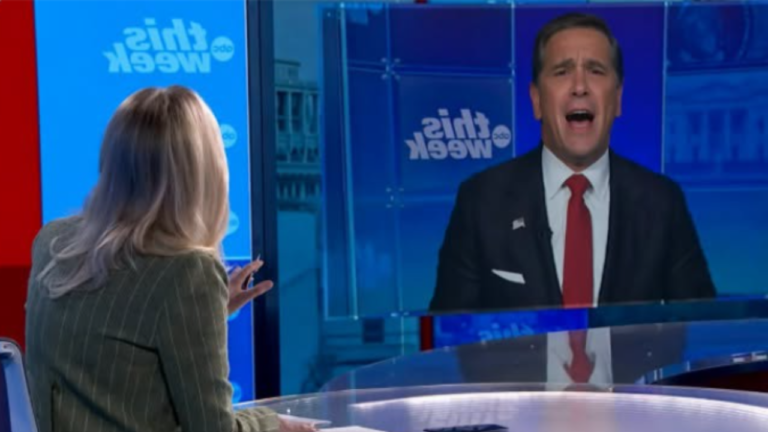
Attorney General Todd Blanche got an extremely simple challenge from ABC’s Martha Raddatz Sunday morning after arguing that inaccurate reporting by CNN and other news organizations can become a national security issue.
“Give us an example,” Raddatz said.
Blanche clearly did not appreciate the question.
“I’m sorry, wait, give you an example of when CNN doesn’t report accurately?!” Blanche fired back. “You cannot be asking me that!”
And that was only the beginning.
The fiery exchange on ABC’s This Week came amid the Trump administration’s ongoing legal battle over its decision to bar CNN, MS NOW and Politico journalists from the White House.
Earlier this week, Trump-appointed federal Judge Timothy Kelly issued a temporary restraining order requiring the White House to temporarily restore the journalists’ credentials.
Kelly also raised a major problem with the administration’s national-security defense.
Raddatz quoted directly from his ruling, noting that Kelly found “nothing in the record” predating the lawsuit suggesting that national security concerns motivated the revocation of the journalists’ hard passes.
Instead, Kelly noted, Trump had publicly focused on what he described as dishonest and negative reporting when announcing the ban.
So Raddatz pressed Blanche on the apparent gap between Trump’s public explanation and the national-security argument his Justice Department later made in court.
Blanche declined to discuss the specifics of Kelly’s ruling because the litigation remains ongoing.
But he insisted the administration’s position was clear.
“What they say is exactly the issue when it comes to national security,” Blanche argued.
That prompted Raddatz’s remarkably straightforward follow-up:
“Give us an example.”
And that’s when things really took off.
“I’m sorry, wait, give you an example of when CNN doesn’t report accurately?!” Blanche responded. “You cannot be asking me that!”
Rather than immediately identify the specific example Raddatz requested, Blanche pivoted to a broader attack on CNN and other networks, claiming their coverage is overwhelmingly negative toward Trump.
Raddatz reminded him that Kelly had rejected the national-security argument at this stage of the case.
Blanche pushed back, correctly noting that Kelly’s order is temporary and that the underlying litigation is not over.
But Raddatz wasn’t finished.
She followed Blanche’s argument to its logical next question: Would the administration begin screening journalists before allowing them onto presidential flights or into the White House?
That set him off again.
“I DID NOT SAY THAT!” Blanche snapped.
“No, no, I did not say that! You don’t get to put words into my mouth!”
Raddatz responded that she wasn’t.
“I’m not defending myself!” Blanche continued. “You said I said something that I didn’t say.”
Raddatz eventually moved to an even more fundamental question.
“What do you think the job of the press is? What does the First Amendment mean to you?”
Blanche said journalists are “free to report whatever they want,” but argued that physical access to the White House is different.
“When it comes to the White House, it is the people’s house,” Blanche said. “It is a privilege and not a right to be there.”
He went on to say Americans should expect news coverage to have at least “a whiff of impartiality” and “a whiff of accuracy.”
Raddatz then brought the conversation right back to Trump’s own words, pointing to his complaint that the outlets “want to try and diminish the Republicans and a Republican administration.”
Blanche accused her of cherry-picking the president’s remarks.
“You just picked out seven words the president said,” he responded, calling her characterization “extraordinarily disingenuous.”
But the most revealing exchange had already happened.
The Justice Department is arguing that inaccurate reporting can rise to the level of a national-security concern.
A federal judge has questioned whether national security was actually behind the original decision.
And when Raddatz asked the attorney general for an example to support what he was saying, his immediate response was not to provide one.
It was:
“You cannot be asking me that.”
About the Author