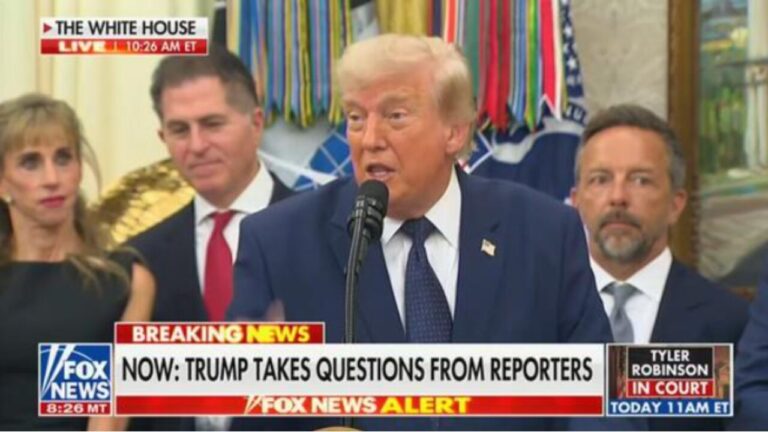
Donald Trump went to the Supreme Court on Wednesday to try and convince nine justices to take away citizenship from 200,000 babies born in the U.S. every year. He left looking embarrassed, and his motorcade quickly left down Independence Avenue before the other side even finished speaking.
Trump made a rare move by appearing in person at the court’s oral arguments for his case about birthright citizenship.
He became the first president in history to do this. He arrived ten minutes early and sat in the front row, probably to send a strong message. But the message the justices gave him wasn’t the one he wanted.
Within 90 minutes, many of the court’s conservative judges — those Trump had either appointed or supported — started to challenge his arguments.
Chief Justice John Roberts called part of the government’s position “quirky.” Justices Neil Gorsuch and Amy Coney Barrett also showed serious doubt. When Trump’s lawyer tried to justify changing the law based on modern issues like “birth tourism,” Roberts responded with a sharp remark: “Well, it’s a new world. It’s the same Constitution.”
Trump didn’t wait to hear more.
His motorcade was seen leaving the Supreme Court at 11:25 a.m., while the other side’s lawyer was still being questioned. The man who came to show strength left before the other team even had a chance to speak.
What was really at stake in that courtroom was Trump’s executive order, which he signed on his first day back in power.
The order would end automatic citizenship for children born in the U.S. to undocumented immigrants or visa holders. It has been blocked by courts since it was signed. If it is allowed, it would take away citizenship from about 200,000 babies each year. By 2050, it could leave 6.4 million U.S.-born children without legal status — people with no nationality, even though they were born in the country they know best. It would have a bigger impact on Hispanic and Asian families, and could even leave newborns without citizenship anywhere in the world.
This move aimed to change the 14th Amendment, which was passed in 1868 to make sure that no one born in the U.S. would be treated as an underclass.
For 157 years, the Constitution has given clear answers to this question. On Wednesday, even Trump’s judges seemed to understand that. While we’ll have to wait for the official ruling to see what the court decides, Trump’s quick exit from the court shows what’s likely to happen — and it’s not what he wanted.
Trump came to the Supreme Court to make history.
He did — just not the kind he was hoping for.
About the Author