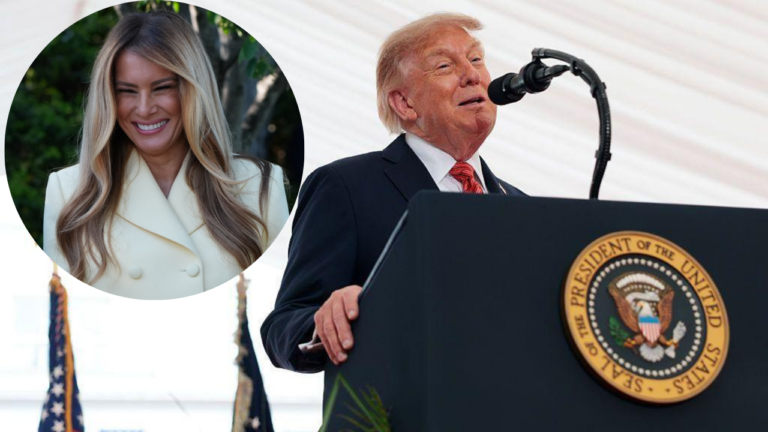
Donald Trump posted on Truth Social saying that countries that were affected by the shutdown of the Strait of Hormuz should buy American oil or go there and “just TAKE it.” He specifically mentioned the United Kingdom and France for not helping. He claimed that the “hard part is done” and said the United States would no longer be there to assist them.
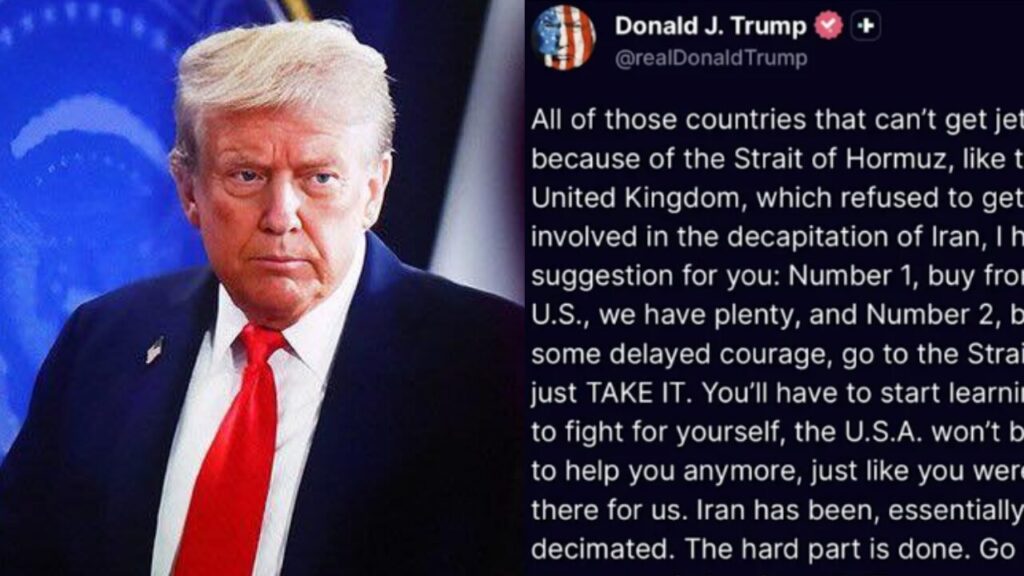
This post was meant to sound strong.
It came out hours after two of America’s NATO allies had already said they wouldn’t take part in the war.
That post was supposed to sound like strength.
Spain did more than complain.
It stopped the U.S. from using military bases they shared for Iran-related actions and also shut down its airspace to U.S. warplanes involved in the attacks. Spain’s Defense Minister, Margarita Robles, said Madrid would not allow either bases or airspace for actions related to the conflict. Spain has been clear: it views the war as one-sided and illegal, and it is not just expressing opposition—it’s refusing.
Italy also said no, which was more damaging.
Spain’s refusal fits with Pedro Sánchez’s political views. Italy, however, is different. Giorgia Meloni has close ties to Trump and has been careful not to publicly go against Washington. Yet Reuters reported that Rome denied U.S. military aircraft permission to land at Sigonella in Sicily because Washington had not sought prior authorization, which Italian treaties require. Italy said there were no problems and that each request is looked at individually. In practice, this means no automatic approval, no blanket permission, and no free use of allied land just because Washington asks.
When Sánchez says no, the White House can call it left-wing posturing.
When Meloni says no, the excuse disappears. The friendly government followed the rules rather than obeying orders. That difference is what Trump’s post was really reacting to.
Iran Noticed the Difference
This detail should concern the White House more than any social media debate.
After Spain refused, the Iranian embassy in Madrid said it would be open to any request from Spain related to transit through the Strait of Hormuz because Spain respects international law.
Read that closely.
Tehran is openly making a distinction between NATO members it sees as hostile and those it believes can still be dealt with. Spain’s refusal bought something that Washington’s yes-men don’t currently have—room. Iran is not offering Spain an alliance, but a tier. And the fact that tiers now exist inside the Western alliance based on who stood with the U.S. and who did not is a bigger issue than one angry president yelling about oil on social media.
The Post Admitted What the Bravado Was Trying To Hide
Take away the all-caps, and the message was simple.
The allies didn’t come when called. The war is affecting fuel markets. And the president’s response was telling them to take care of themselves. That’s not how leaders speak when coalitions are strong. That’s how they speak when they expected to be obeyed but got procedures, hesitations, and outright refusals instead.
PRESIDENT TRUMP:
— The Kobeissi Letter (@KobeissiLetter) March 31, 2026
“All of those countries that can’t get jet fuel because of the Strait of Hormuz, like the United Kingdom, which refused to get involved in the decapitation of Iran, I have a suggestion for you: Number 1, buy from the U.S., we have plenty, and Number 2, build up… pic.twitter.com/ovUwFCk6eY
Trump can frame this as toughness for his base.
The “just TAKE it” line will work on Truth Social as all his lines do—like bluster that sounds like a command. But outside that audience, the post reads like a man realizing in real time that the war he started is becoming the war he owns. The “hard part” isn’t done. The hard part is that the countries he needs are doing the math and realizing the cost of standing with Washington is higher than the cost of standing apart.
The War Is Sorting Allies Into Categories. Trump Is Helping
The pattern is already visible. Spain refused and got a diplomatic opening from Tehran. Italy refused and kept its procedural credibility intact. The UK and France got called out by name on Truth Social for not helping. And the United States is running a military campaign in the Middle East while its president publicly tells allied nations they are on their own.
Every war tests an alliance. The question is always whether the coalition holds under pressure or starts sorting itself into tiers — countries that comply, countries that hedge, and countries that refuse. What makes this one different is that the sorting is not happening quietly in back channels. It is happening on Truth Social, in Spanish airspace closures, in Italian procedural denials, and in Iranian embassy statements addressed to individual NATO members by name.
Trump told his allies to go take the Strait of Hormuz. Two of them had already told him they would not help take Iran. So, which is it — an alliance, or a president finding out how many friends he has left when the war is his idea and the bill is everyone else’s?
About the Author